E129: Euler lucky constants for \(n^2 + n + b\)
Tags: number-theory, quantitative-exploration, visualization, primes, heuristics
See: Valid Tags.
Highlights
Compares several classical “lucky” constants \(b\) side-by-side.
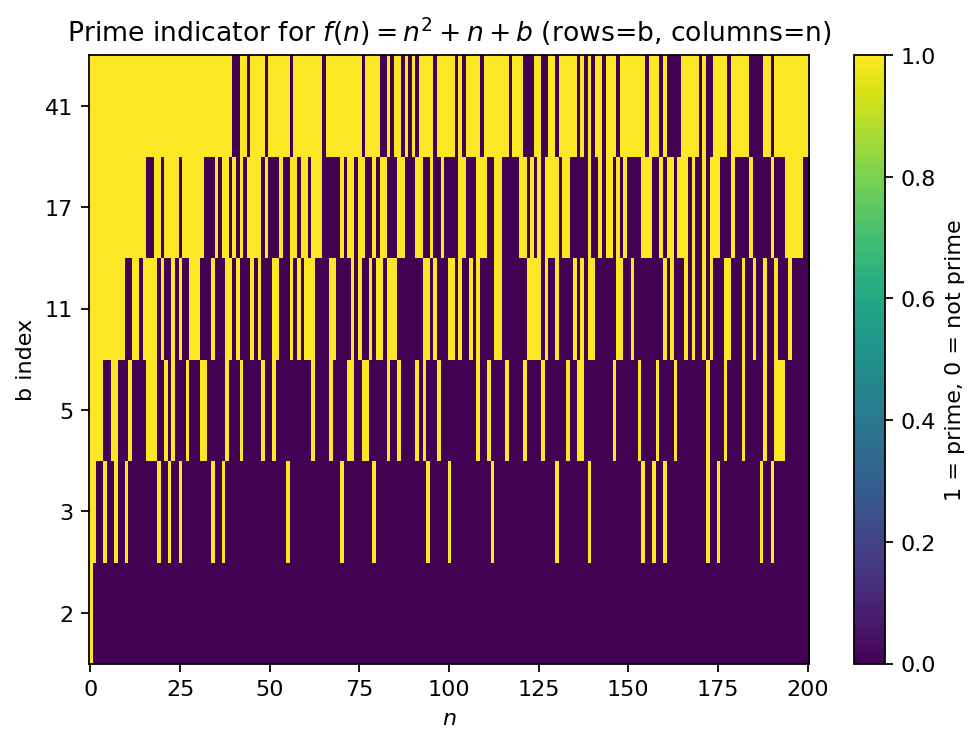
Heatmap shows prime/composite patterns across \(n\) for each \(b\).
Report includes the first failure \(n\) and a factorization witness.
Goal
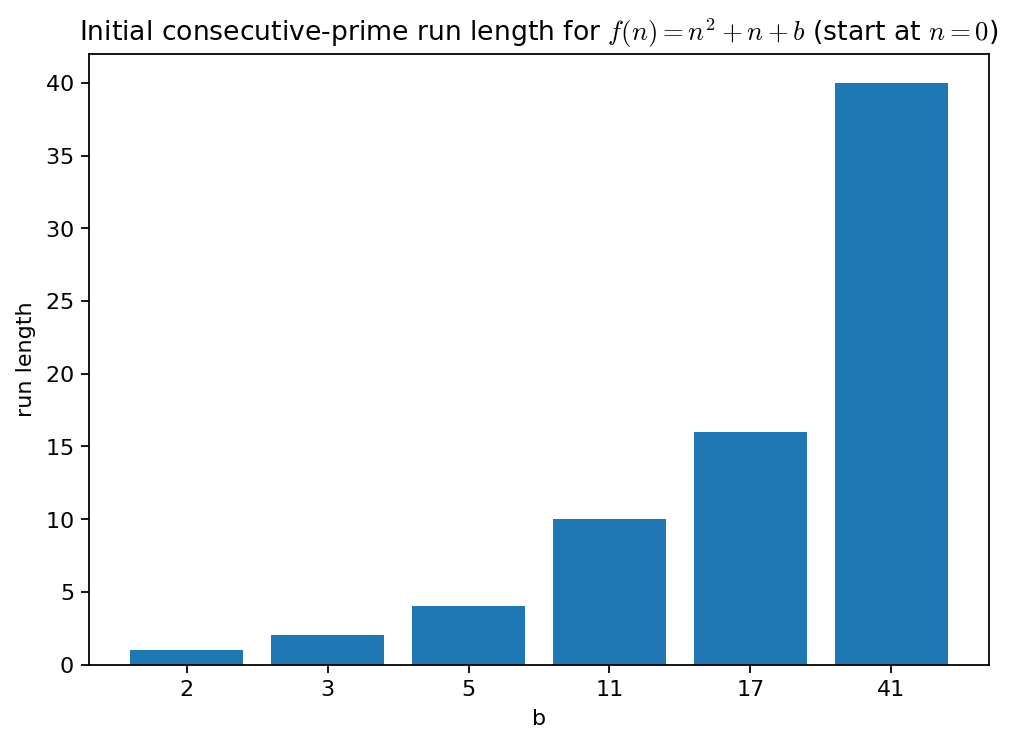
Compare how long \(n^2+n+b\) stays prime at the start for a small set of classical constants \(b\). We quantify the initial prime streak length and visualize where it breaks.
Background (quick refresher)
Research question
Among a short list of traditional “Euler lucky numbers” \(b\), which yields the longest initial prime streak for \(f(n)=n^2+n+b\) and how do the failures look (first composite and its factors)?
Method
Choose a list of constants \(b\).
For each \(b\), evaluate \(f(n)\) for \(n=0..N\).
Use a sieve to classify values as prime/composite and measure the initial run length.
Visualize a prime indicator map and a bar chart of run lengths.
How to run
make run EXP=e129
or:
uv run python -m mathxlab.experiments.e129
Outputs
This experiment follows the standard output contract:
out/e129/figures/— generated figures (PNG)out/e129/report.md— short narrative reportout/e129/params.json— run parameters (stable JSON)out/e129/logs/— run logs (created by the runner/Makefile)
Published run snapshot
If this experiment is included in the docs gallery, include the published snapshot (report + params).
Reproduce:
make run EXP=e129
Parameters
n_max:
200b_values:
[2, 3, 5, 11, 17, 41]
Summary
b |
initial prime run |
first non-prime n |
f(n) |
factorization |
|---|---|---|---|---|
2 |
1 |
1 |
4 |
2^2 |
3 |
2 |
2 |
9 |
3^2 |
5 |
4 |
4 |
25 |
5^2 |
11 |
10 |
10 |
121 |
11^2 |
17 |
16 |
16 |
289 |
17^2 |
41 |
40 |
40 |
1681 |
41^2 |
Notes
Many quadratics look prime-rich on small ranges; a short streak does not imply a deep theorem.
For any fixed b, there are always modular obstructions (e.g. the b-multiple subsequence for n=bk when b is prime).
Outputs
figures/fig_01_prime_indicator_heatmap.pngfigures/fig_02_initial_run_lengths.pngparams.jsonreport.md
params.json (snapshot)
{
  "b_values": [
    2,
    3,
    5,
    11,
    17,
    41
  ],
  "max_listed": 10,
  "n_max": 200,
  "seed": 1
}