E008: Lucas–Lehmer scan (prime exponents)
Tags: number-theory, quantitative-exploration, visualization
See: Valid Tags.
Highlights
Run the Lucas–Lehmer test for many prime exponents \(p\).
Record timing and residue behavior for composite vs. prime outcomes.
Produce a reproducible “scan report” (which \(p\) were tested, which passed).
Goal
Empirically explore Mersenne primality testing by scanning prime exponents \(p\) and applying the Lucas–Lehmer test to \(M_p = 2^p - 1\).
Background (quick refresher)
Research question
For prime exponents \(p \le P\), how does:
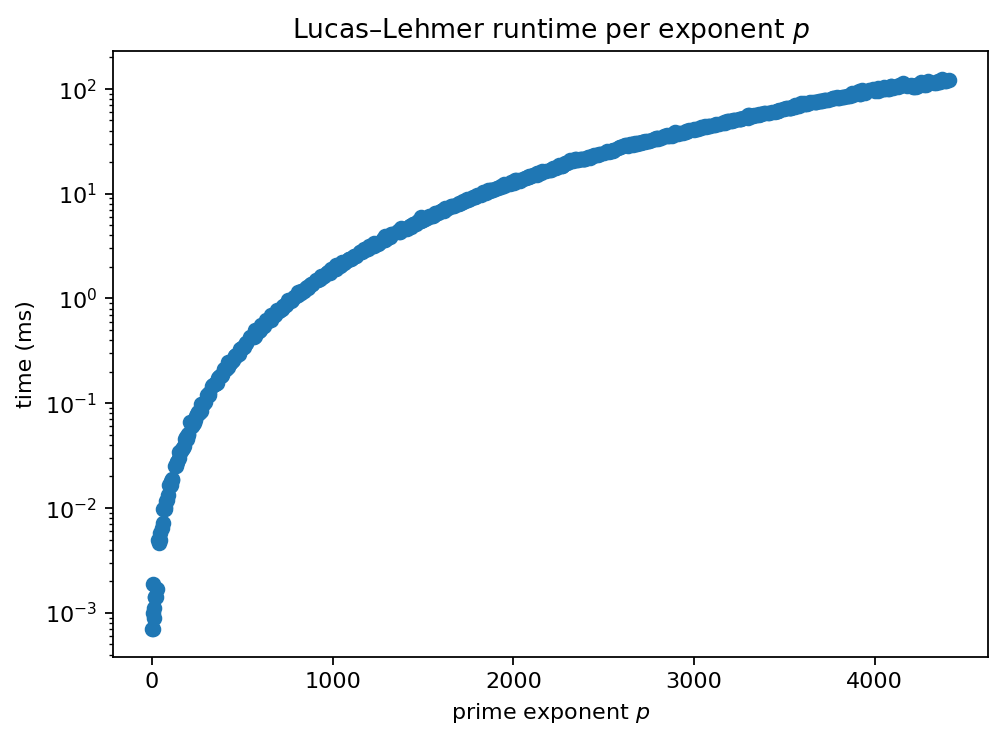
runtime of the Lucas–Lehmer test scale with \(p\)?
the distribution of final residues (mod \(M_p\)) differ between prime and composite outcomes?
Why this qualifies as a mathematical experiment
Finite procedure: enumerate prime exponents up to a bound and test them.
Observable(s): pass/fail, final residue, and runtime.
Parameter space: vary \(P\) and optional “max tests” cap.
Outcome: a dataset (tested \(p\) values) and plots/tables that suggest scaling behavior.
Failure modes: naive implementations can be slow; parameters bound the search to keep runs feasible.
Experiment design
Computation
Enumerate prime exponents \(p\) up to a bound \(P\).
For each \(p\), compute \(M_p = 2^p - 1\) and run Lucas–Lehmer:
\(s_0 = 4\)
\(s_{k+1} = s_k^2 - 2 \pmod{M_p}\)
\(M_p\) is prime iff \(s_{p-2} \equiv 0 \pmod{M_p}\).
Record (at minimum): \(p\), pass/fail, final residue, and wall time.
Outputs
table: scanned exponents with result and time
plot: \(p\) vs. runtime (often log-scale is helpful)
plot: residue magnitude / patterns (optional)
How to run
make run EXP=e008
or:
uv run python -m mathxlab.experiments.e008
Notes / pitfalls
Only run Lucas–Lehmer for prime \(p\); if \(p\) is composite then \(M_p\) is composite.
The test is defined for odd prime \(p\); treat \(p=2\) separately (\(M_2=3\) is prime).
Keep bounds modest at first; the cost grows quickly with \(p\).
Extensions
Add a “pre-sieve” that checks for small factors before running Lucas–Lehmer.
Compare your timings to published implementations (as a sanity check, not a competition).
Published run snapshot
If this experiment is included in the docs gallery, include the published snapshot (report + params).
Reproduce:
make run EXP=e008
Parameters
p_max:
10000max_tests:
600
Results
tested exponents:
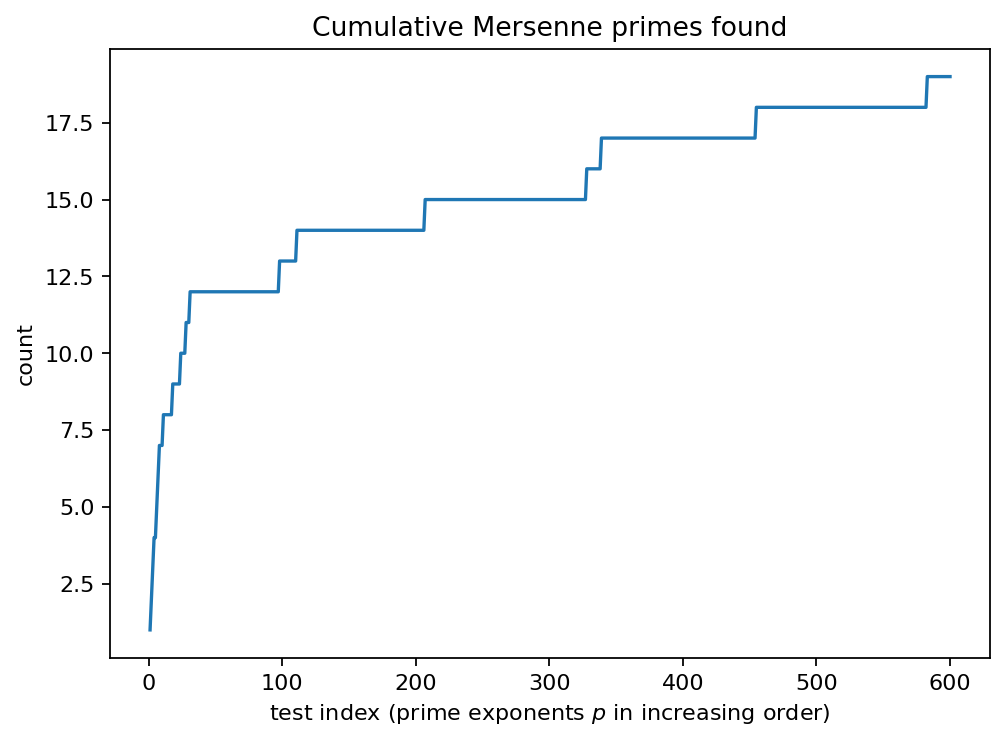
600Mersenne primes found:
19
Prime exponents p where M_p is prime
2, 3, 5, 7, 13, 17, 19, 31, 61, 89, 107, 127, 521, 607, 1279, 2203, 2281, 3217, 4253
Notes
LLT is a deterministic primality test specialized to M_p = 2^p - 1.
Only prime exponents p need to be tested: if 2^n-1 is prime, then n must be prime.
params.json (snapshot)
{
  "max_tests": 600,
  "p_max": 10000
}
References
See References.
[Caldwell, 2021, contributors, 2025, Mersenne Research, 2024]