E011: Heuristic rarity of Mersenne primes
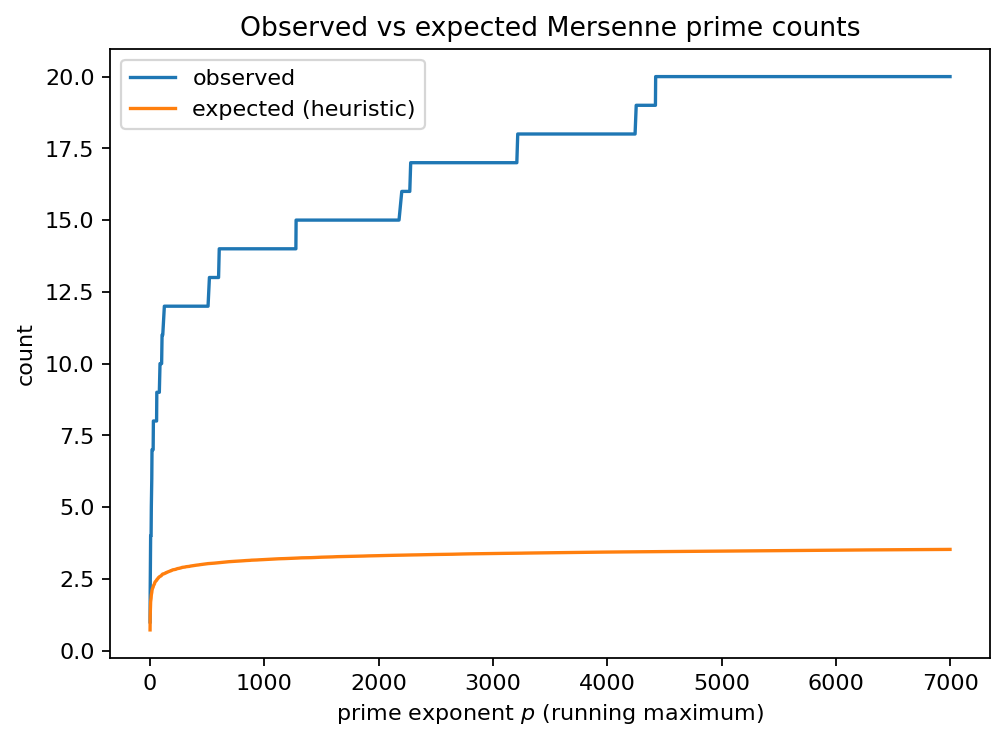
Tags: number-theory, quantitative-exploration, visualization
See: Valid Tags.
Highlights
Compare observed Mersenne-prime counts to a simple heuristic expectation curve.
Visualize cumulative “found vs. expected” as exponent bounds increase.
Keep the discussion explicitly empirical (evidence, not proof).
Goal
Mersenne primes are extremely rare. This experiment compares:
the observed count of Mersenne primes among prime exponents \(p \le P\)
a lightweight heuristic curve that grows slowly with \(P\)
The aim is intuition-building and trend visualization, not a rigorous model.
Background (quick refresher)
Research question
For increasing prime exponent bounds \(P\):
how does the cumulative count of “passes” from your scan grow?
how does it compare to a simple expectation curve of the form:
\[ E(P) \approx \sum_{p \le P,\ p\ \mathrm{prime}} \frac{1}{p\ln 2} \]
Why this qualifies as a mathematical experiment
Finite procedure: run a finite scan and compute a finite expected sum.
Observable(s): cumulative count of passes vs. cumulative expected value.
Parameter space: vary \(P\) (and optionally cap runtime per test).
Outcome: plots that show agreement/divergence and suggest questions for deeper study.
Failure modes: small ranges are noisy; the experiment should clearly label bounds.
Experiment design
Computation
From E008 (or a fixed list), get the set of exponents tested and which passed.
For each bound \(P\), compute:
\(\mathrm{Found}(P)\) = number of passing exponents \(p \le P\)
\(E(P)\) = cumulative heuristic sum
Plot both curves against \(P\).
Outputs
plot: \(P\) vs. Found(P) and E(P)
table: selected checkpoints (P, Found, E)
How to run
make run EXP=e011
or:
uv run python -m mathxlab.experiments.e011
Notes / pitfalls
The heuristic curve is a comparison tool, not a theorem.
Results depend heavily on which exponents were actually tested; record the tested set in the report.
A single large Mersenne prime can dominate impressions—keep axes and annotations clear.
Extensions
Compare multiple heuristics (still empirical) and see which best matches the observed range.
Extend the scan bound and see whether the deviation grows or stabilizes.
Published run snapshot
If this experiment is included in the docs gallery, include the published snapshot (report + params).
Reproduce:
make run EXP=e011
Parameters
p_max:
20000max_tests:
900
Summary
largest tested p:
6997observed count:
20expected (heuristic):
3.52597
Found Mersenne prime exponents
2, 3, 5, 7, 13, 17, 19, 31, 61, 89, 107, 127, 521, 607, 1279, 2203, 2281, 3217, 4253, 4423
Notes
The heuristic probability is ~ 1/(p·ln 2) for prime p.
This is not a theorem; it is a back-of-the-envelope model for rarity.
params.json (snapshot)
{
  "max_tests": 900,
  "p_max": 20000
}
References
See References.