E009: Small-factor scan for Mersenne numbers
Tags: number-theory, quantitative-exploration, visualization
See: Valid Tags.
Highlights
Quickly eliminate many \(M_p\) candidates by finding small prime factors.
Use the structure of possible factors of \(M_p\) to reduce wasted work.
Show how often “trivial” factors appear in a range of exponents.
Goal
Explore how often Mersenne numbers \(M_p = 2^p - 1\) (with prime \(p\)) have small factors, and how a lightweight sieve can filter candidates before running Lucas–Lehmer.
Background (quick refresher)
Research question
For prime exponents \(p \le P\) and a factor bound \(q \le Q\):
how many \(M_p\) have a factor below \(Q\)?
how much compute can be saved by sieving before Lucas–Lehmer?
Why this qualifies as a mathematical experiment
Finite procedure: scan a finite range of \(p\) and candidate factors.
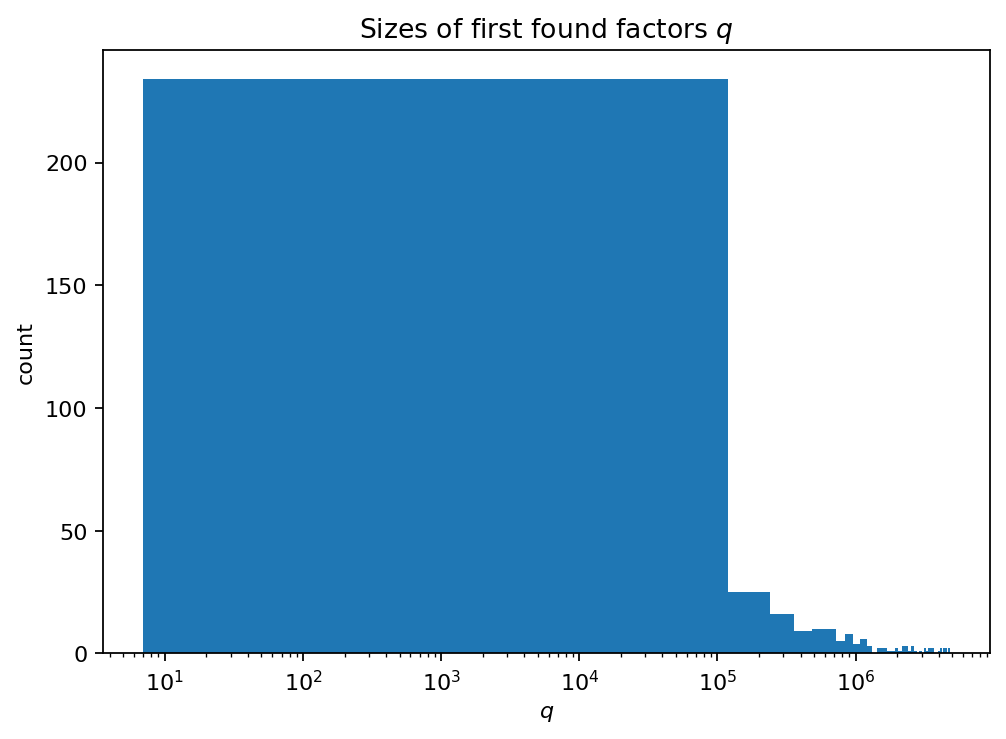
Observable(s): first small factor found (if any), counts by \(p\) and by factor size.
Parameter space: vary \(P\) and \(Q\).
Outcome: tables/plots that show factor frequency and sieve effectiveness.
Failure modes: incomplete sieve bounds can mislead; clearly report \(Q\) as a limitation.
Experiment design
Computation
For fixed prime exponent \(p\), any prime factor \(q\) of \(M_p\) satisfies:
\(q \equiv 1 \pmod{2p}\) (a common necessary condition used to generate candidates)
A practical sieve approach:
Generate candidate primes \(q\) of the form \(q = 2pk + 1\) up to \(Q\).
For each candidate prime \(q\), check:
\(2^p \equiv 1 \pmod{q}\)
If true, then \(q\) divides \(M_p\).
Outputs
table: per \(p\), smallest factor found (or “none up to \(Q\)”)
plot: \(p\) vs. smallest factor (when present)
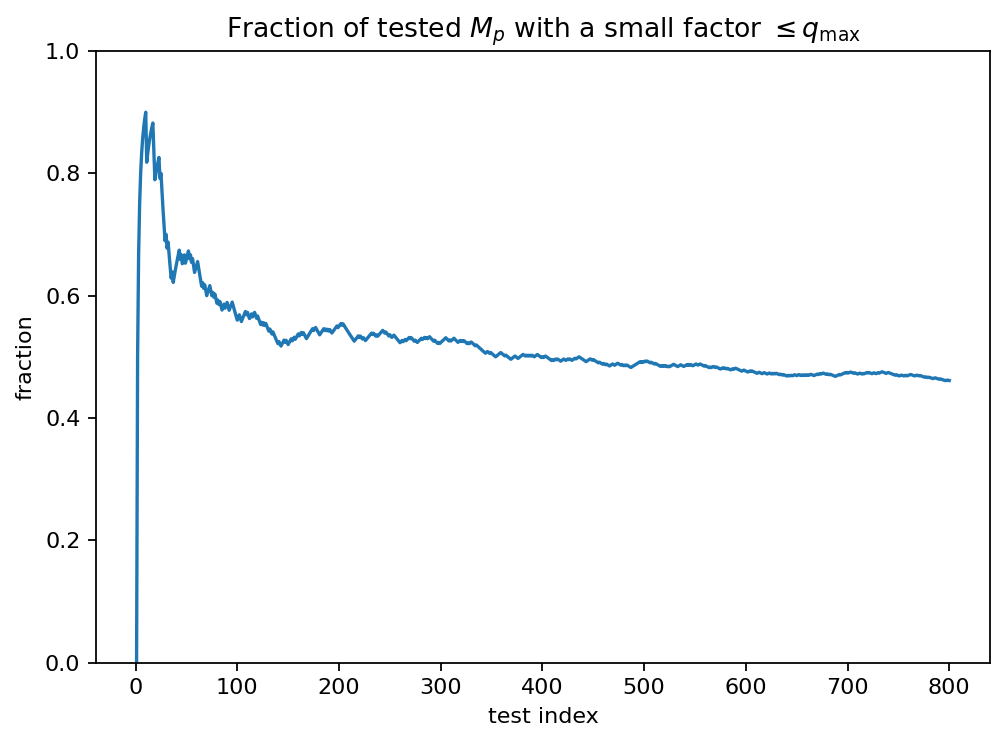
summary: fraction of \(p\) eliminated by the sieve
How to run
make run EXP=e009
or:
uv run python -m mathxlab.experiments.e009
Notes / pitfalls
This is a bounded sieve: “no factor found” only means “none found up to \(Q\)”.
Prime testing for \(q\) should be fast; for small \(Q\), a simple deterministic method is fine.
Report both \(P\) and \(Q\) prominently in the report.
Extensions
Combine with E008: run Lucas–Lehmer only on exponents not eliminated by the sieve.
Track how much wall time is saved by the combined pipeline.
Published run snapshot
If this experiment is included in the docs gallery, include the published snapshot (report + params).
Reproduce:
make run EXP=e009
Parameters
p_max:
10000max_tests:
800q_max:
5000000require_q_prime:
True
Results
tested exponents:
800with small factor found:
369
Sample (first 20 with a found factor)
p |
factor q |
|---|---|
3 |
7 |
5 |
31 |
7 |
127 |
11 |
23 |
13 |
8191 |
17 |
131071 |
19 |
524287 |
23 |
47 |
29 |
233 |
37 |
223 |
41 |
13367 |
43 |
431 |
47 |
2351 |
53 |
6361 |
59 |
179951 |
71 |
228479 |
73 |
439 |
79 |
2687 |
83 |
167 |
97 |
11447 |
Notes
The congruence filter q ≡ 1 (mod 2p) is necessary but not sufficient.
A found q certifies M_p is composite; it does not factor M_p completely.
params.json (snapshot)
{
  "max_tests": 800,
  "p_max": 10000,
  "q_max": 5000000,
  "require_q_prime": true
}
References
See References.