E048: Carmichael numbers: Korselt scan + Fermat counterexamples
Tags: number-theory, counterexample-search, quantitative-exploration, visualization, carmichael, pseudoprime
See: Valid Tags.
Highlights
Enumerates many small Carmichael numbers by scanning squarefree products of three primes.
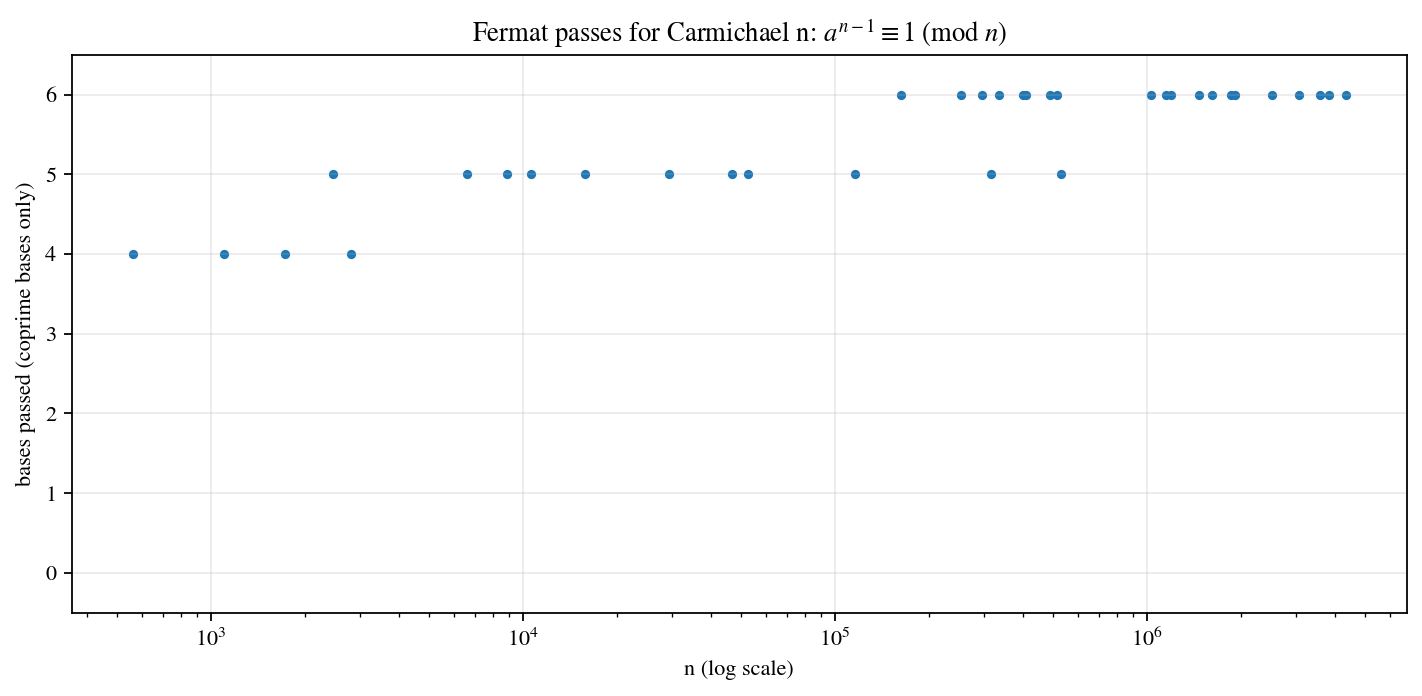
Verifies that these composites pass Fermat’s test for several common bases.
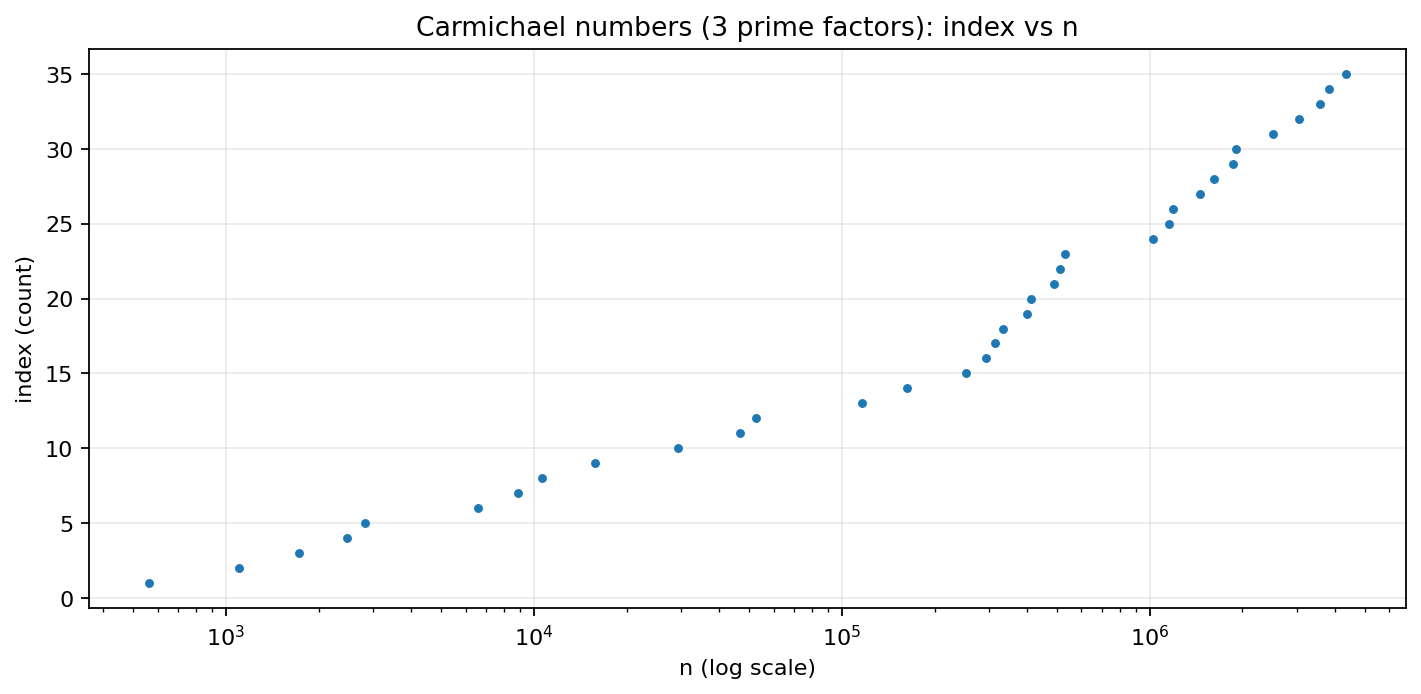
Visualizes the distribution of discovered Carmichael numbers on a log scale.
Goal
Show that Fermat’s primality test can fail spectacularly, and produce a dataset of explicit counterexamples.
Background (quick refresher)
Research question
Within a moderate bound \(N\), how many Carmichael numbers can we find by a simple Korselt scan, and how many Fermat bases do they fool?
Experiment design
Enumerate candidates \(n=pqr\le N\) with distinct primes \(p<q<r\).
Apply Korselt’s criterion: \((p-1)\mid(n-1)\) for each prime factor \(p\mid n\).
For each Carmichael \(n\), test Fermat congruence for a small base set (skipping non-coprime bases).
Plot index vs. \(n\) and “bases passed” vs. \(n\).
Reproducibility
params.jsonrecords the run settings.report.mdsummarizes the key findings.figures/*.pngcontains the plots for the run.
Interpreting the results
All numbers found are composite by construction, yet they pass Fermat congruences for all coprime bases (in theory).
The scan is restricted to 3-prime-factor Carmichael numbers; larger-factor Carmichaels exist too.
Seeing “all bases passed” in the plot is a strong reminder: Fermat alone is not a reliable primality test.
Published run snapshot
If this experiment is included in the docs gallery, include the published snapshot (report + params).
Parameters
n_max: 5000000
bases: 2, 3, 5, 7, 11, 13
Smallest Carmichael numbers found (3 prime factors)
n |
factorization |
Fermat bases passed |
|---|---|---|
561 |
3·11·17 |
4 |
1105 |
5·13·17 |
4 |
1729 |
7·13·19 |
4 |
2465 |
5·17·29 |
5 |
2821 |
7·13·31 |
4 |
6601 |
7·23·41 |
5 |
8911 |
7·19·67 |
5 |
10585 |
5·29·73 |
5 |
15841 |
7·31·73 |
5 |
29341 |
13·37·61 |
5 |
46657 |
13·37·97 |
5 |
52633 |
7·73·103 |
5 |
115921 |
13·37·241 |
5 |
162401 |
17·41·233 |
6 |
252601 |
41·61·101 |
6 |
294409 |
37·73·109 |
6 |
314821 |
13·61·397 |
5 |
334153 |
19·43·409 |
6 |
399001 |
31·61·211 |
6 |
410041 |
41·73·137 |
6 |
Notes
These n are composite yet pass Fermat’s congruence for all coprime bases.
The scan here is restricted to squarefree products of three primes, which already recovers many classical examples (e.g., 561 = 3·11·17).
params.json (snapshot)
{
  "base_list": [
    2,
    3,
    5,
    7,
    11,
    13
  ],
  "max_results": 5000,
  "n_max": 5000000
}
References
See Alford et al. [1994], Carmichael [1912], The OEIS Foundation Inc. [2025], Wikipedia contributors [2025].