E053: Inverse totient multiplicities
Tags: number-theory, quantitative-exploration, visualization, arithmetic-functions, totient, search
See: Valid Tags.
Highlights
Compute \(\varphi(n)\) for \(n\le N\) and count how many preimages each value has.
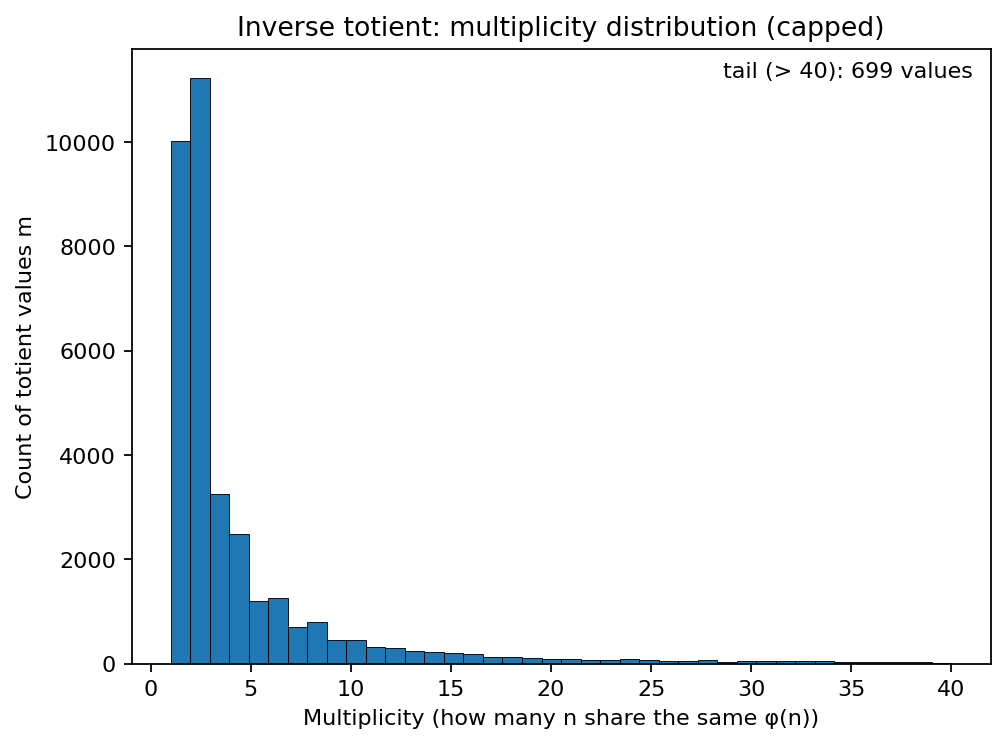
Plot the histogram of multiplicities and list the top collisions.
Goal
Empirically study the many-to-one nature of the totient function.
Background (quick refresher)
Research question
For \(n\le N\), how large can the multiplicity of a totient value get, and what do the maximizers look like?
Method
Compute \(\varphi(n)\) on a range and build a frequency table for values.
Visualize multiplicities (histogram) and inspect the most frequent values.
How to run
make run EXP=e053uv run python -m mathxlab.experiments.e053
Outputs
This experiment follows the standard output contract:
out/e053/figures/— generated figures (PNG)out/e053/report.md— short narrative reportout/e053/manifest.json— snapshot metadata for the gallery
Published run snapshot
If this experiment is included in the docs gallery, include the published snapshot (report + params).
n_max: 200000
Top 10 totient values by multiplicity (count, m):
357 x : m = 40320
332 x : m = 51840
331 x : m = 34560
320 x : m = 60480
307 x : m = 43200
291 x : m = 48384
281 x : m = 30240
280 x : m = 47520
280 x : m = 46080
276 x : m = 25920
Figure:
fig_01_multiplicity_hist.png
params.json (snapshot)
{
  "hist_max": 40,
  "n_max": 200000
}