E004: Computing \(\sigma(n)\) at Scale — Sieve vs. Factorization
Tags: number-theory, quantitative-exploration, numerics, optimization
See: Valid Tags.
Highlights
Benchmark bulk sieve vs. per-number factorization.
Find runtime crossover points as \(N\) grows.
Validate correctness on sampled inputs.
Goal
Benchmark two practical ways to compute the sum-of-divisors function:
Sieve method: compute all \(\sigma(1..N)\) in one pass.
Factorization method: compute \(\sigma(n)\) per-number from the prime factorization.
Research question
For a range of bounds \(N\):
which approach is faster?
where is the crossover point?
what are the memory tradeoffs?
Why this qualifies as a mathematical experiment
Both methods are mathematically equivalent, but performance depends on constants, caching, and implementation details. This is a quantitative exploration of algorithmic behavior grounded in number-theory structure.
Experiment design
Method A: divisor-sum sieve (bulk computation)
Compute sigma[1..N] by adding each divisor to its multiples (as in E003).
Method B: per-number factorization
Factor each \(n\) (e.g. using a precomputed prime list up to \(\sqrt{N}\)) and compute:
If
Measurements
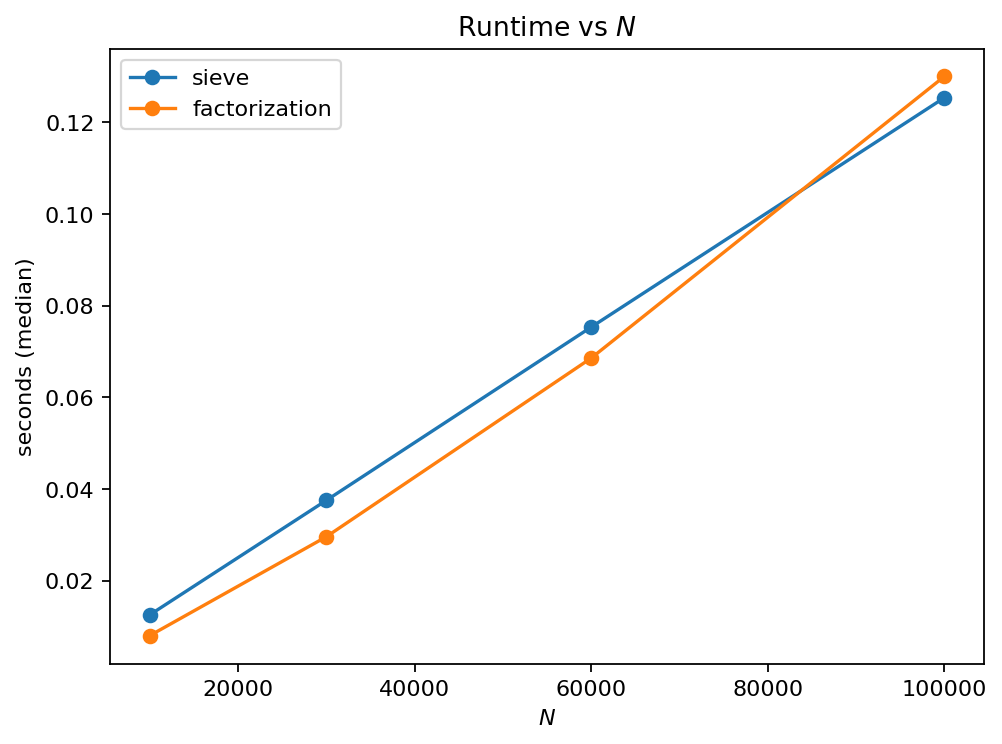
wall-clock runtime vs. \(N\) (multiple trials, median)
peak memory (rough estimate acceptable for v1)
correctness cross-check: random sample where both methods agree
Outputs
plot: runtime vs. \(N\) for both methods
short table: \(N\), runtime(A), runtime(B), speedup
How to run
make run EXP=e004
or:
uv run python -m mathxlab.experiments.e004
Notes / pitfalls
Factorization becomes expensive quickly; keep the factorization method limited to moderate \(N\).
Use integer arithmetic for correctness checks (
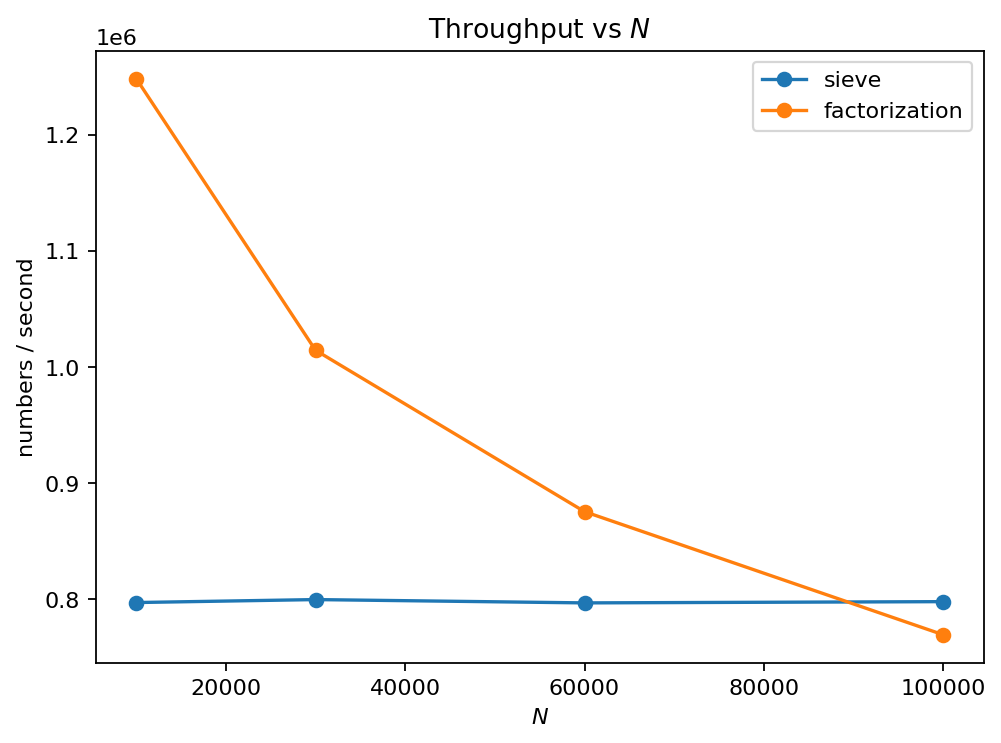
sigma[n] == 2*netc.).Report both runtime and effective throughput (numbers processed per second).
Extensions
Add a third method using smallest-prime-factor (SPF) sieve for fast factorization.
Compare pure Python vs.
numpyarrays for Method A.Turn the benchmark into a reusable utility for later experiments.
Published run snapshot
If this experiment is included in the docs gallery, include the published snapshot (report + params).
Reproduce:
make run EXP=e004
Parameters
n_values:
10000, 30000, 60000, 100000trials:
3
Results (median runtime)
N |
sieve [s] |
factorization [s] |
speedup (sieve/fact) |
|---|---|---|---|
10000 |
0.0103 |
0.0056 |
1.83 |
30000 |
0.0303 |
0.0205 |
1.48 |
60000 |
0.0605 |
0.0476 |
1.27 |
100000 |
0.1020 |
0.0877 |
1.16 |
Notes
Sieve computes all σ(1..N) at once; factorization recomputes structure per number.
Factorization is capped to moderate N to keep runtime reasonable in pure Python.
params.json (snapshot)
{
  "max_n_factor": 100000,
  "n_values": [
    10000,
    30000,
    60000,
    100000
  ],
  "trials": 3
}
References
See References.