E002: Even Perfect Numbers — Generator and Growth
Tags: number-theory, quantitative-exploration, visualization, numerics
See: Valid Tags.
Highlights
Generate even perfect numbers from known Mersenne exponents \(p\).
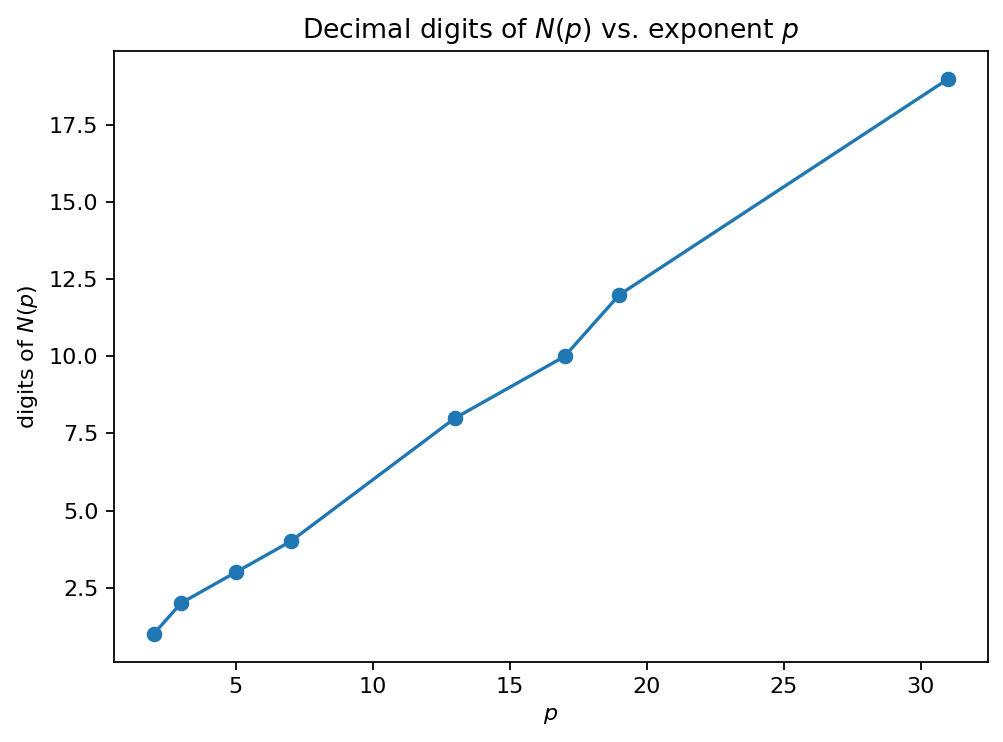
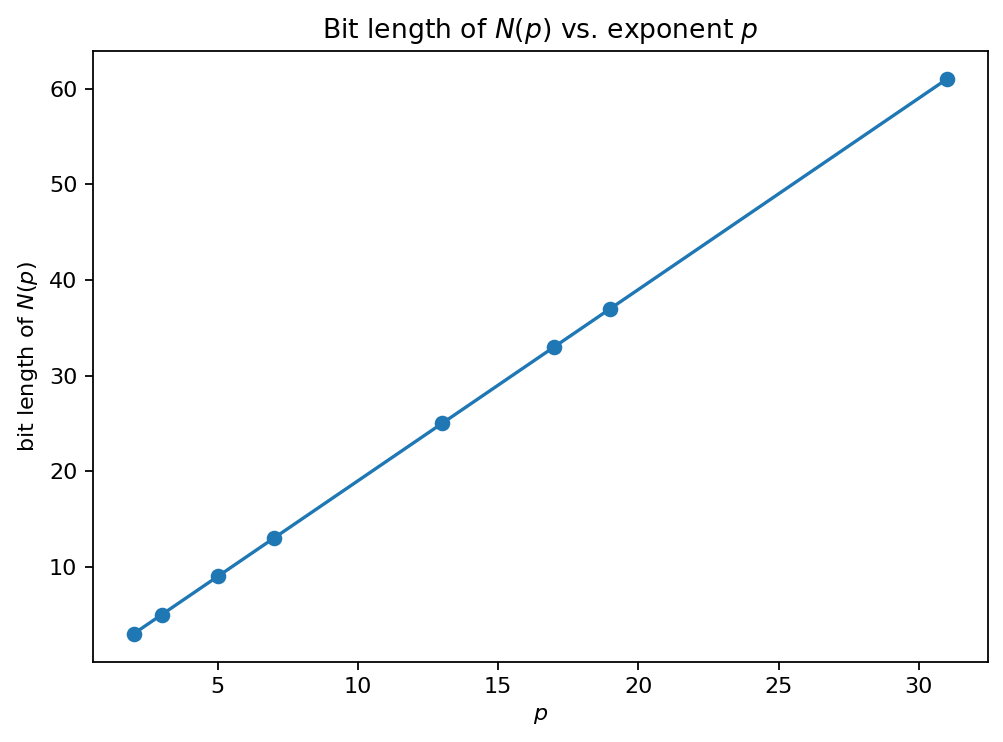
Plot digits and bit-length growth vs. \(p\).
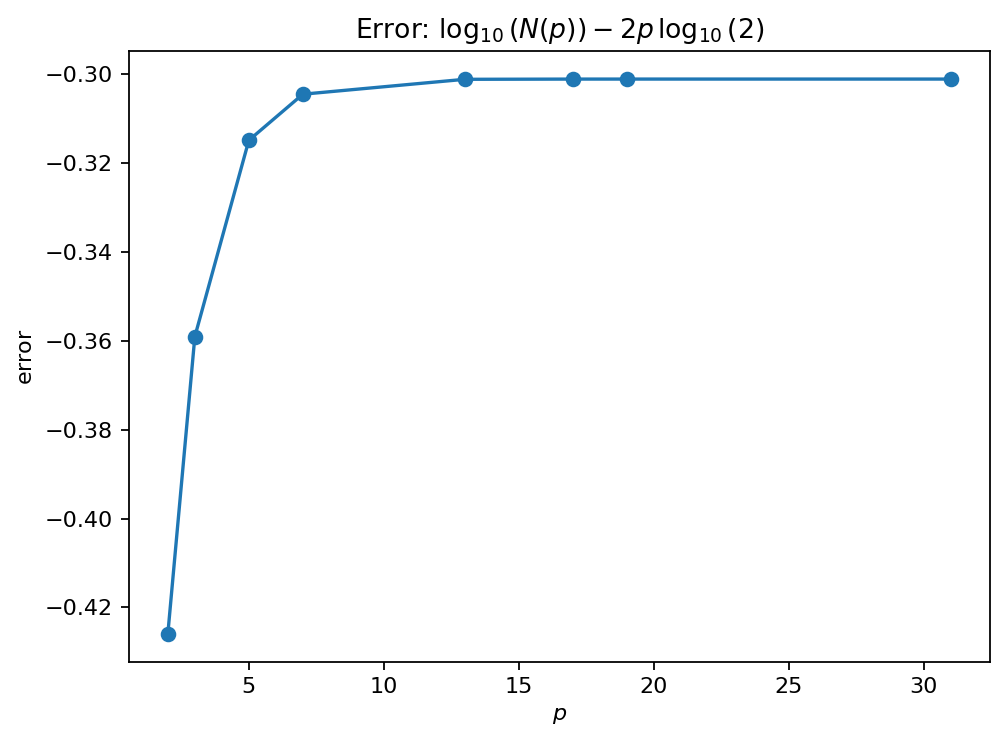
Test the approximation \(\log_{10}(N(p)) \approx 2p\log_{10}(2)\).
Goal
Generate even perfect numbers from known Mersenne prime exponents \(p\) and visualize how fast the numbers grow. Measure growth via digit count, bit length, and simple logarithmic approximations.
Research question
For
\(\mathrm{digits}(N)\),
\(\mathrm{bit\_length}(N)\),
\(\log_{10}(N)\)
scale with the exponent \(p\)?
How accurate is the approximation
Why this qualifies as a mathematical experiment
The Euclid–Euler theorem tells us exactly what even perfect numbers look like, but it does not directly convey how quickly the objects become astronomically large. This experiment uses computation and visualization to build quantitative intuition and test simple asymptotic approximations.
Experiment design
Inputs
A curated list of known Mersenne prime exponents, e.g. \(p \in \{2,3,5,7,13,17,19,31,\dots\}\).
Observables
For each exponent \(p\):
\(N(p)\) as a Python integer
\(\mathrm{digits}(N(p))\)
\(\mathrm{bit\_length}(N(p))\)
approximation error:
\[ \Delta(p) = \log_{10}(N(p)) - 2p\log_{10}(2) \]
Plots
\(p\) vs. digits
\(p\) vs. bit length
\(p\) vs. \(\Delta(p)\)
How to run
From the repo root:
make run EXP=e002
or:
uv run python -m mathxlab.experiments.e002
Notes / pitfalls
Avoid converting huge integers to decimal strings repeatedly in tight loops; compute digits using logs where possible.
Use
int.bit_length()for stable bit length (fast and exact).Keep the exponent list modest for fast docs builds; this is a growth experiment, not a search for new Mersenne primes.
Extensions
Compare growth to \(2^{2p}\) and quantify the relative gap.
Add a “human scale” axis: compare \(\mathrm{digits}(N(p))\) to common benchmarks (atoms in the observable universe, etc.).
Pull the exponent list from a small data file so the experiment can be updated without code changes.
Published run snapshot
If this experiment is included in the docs gallery, include the published snapshot (report + params).
Reproduce:
make run EXP=e002 ARGS="--seed 1"
Seed: 1
Exponents
Mersenne prime exponents used in this run:
2, 3, 5, 7, 13, 17, 19, 31
Outputs
figures/fig_01_digits_vs_p.pngfigures/fig_02_bits_vs_p.pngfigures/fig_03_log10_error_vs_p.pngparams.json
Notes
Growth is extreme: both digits and bit length scale roughly linearly in
p.The log-approximation error stays bounded and illustrates why
N(p)behaves like2^(2p)up to a small correction.
params.json (snapshot)
{
  "exponents": [
    2,
    3,
    5,
    7,
    13,
    17,
    19,
    31
  ]
}
References
See References.