E047: Fermat numbers: Pépin test + factor witnesses
Tags: number-theory, counterexample-search, visualization, fermat
See: Valid Tags.
Highlights
Runs Pépin’s test for \(F_n = 2^{2^n} + 1\) (definitive for Fermat numbers).
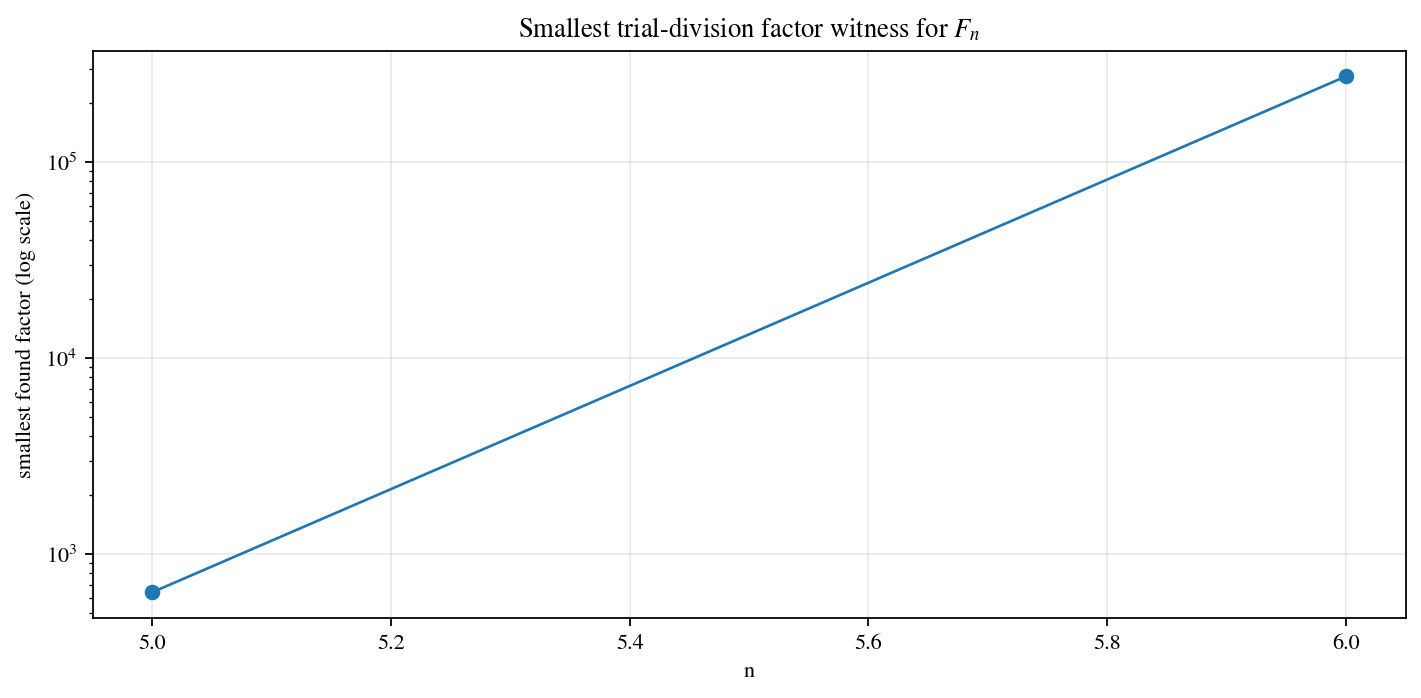
Finds small, explicit factor witnesses by bounded trial division.
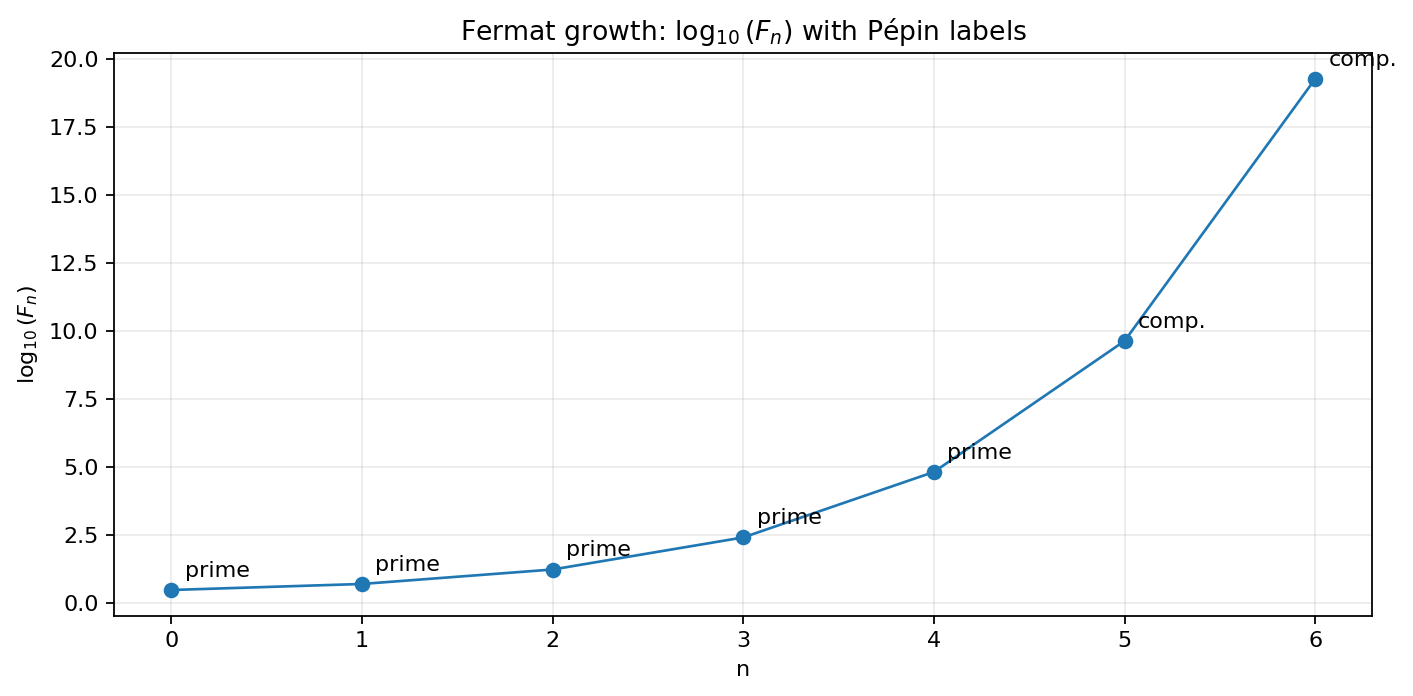
Visualizes how explosively \(F_n\) grows and where the first counterexample appears.
Goal
Demonstrate (computationally) why the statement “all Fermat numbers are prime” fails, and produce concrete witnesses.
Background (quick refresher)
Research question
How quickly do Fermat numbers become composite in practice, and how easy is it to exhibit a witness factor for the first failures?
Experiment design
Compute \(F_n\) for \(n\le n_{max}\).
Apply Pépin’s test (for \(n\ge 1\)) to classify prime vs. composite.
If composite, attempt to find a small factor by trial division up to a configurable bound.
Plot \(\log_{10}(F_n)\) and the smallest discovered factor (if any).
Reproducibility
params.jsonrecords the run settings.report.mdsummarizes the key findings.figures/*.pngcontains the plots for the run.
Interpreting the results
If Pépin says “composite”, the number is definitively composite (not a probabilistic claim).
The factor search is bounded: “no factor found” does not mean “prime”.
The classic factor for \(F_5\) (and often for \(F_6\)) appears quickly under the default bounds.
Published run snapshot
If this experiment is included in the docs gallery, include the published snapshot (report + params).
Parameters
n_max: 6
factor_prime_bound: 1000000
Results (bounded)
n |
F_n |
Pépin says prime? |
smallest factor found |
|---|---|---|---|
0 |
3 |
✅ |
— |
1 |
5 |
✅ |
— |
2 |
17 |
✅ |
— |
3 |
257 |
✅ |
— |
4 |
65537 |
✅ |
— |
5 |
4294967297 |
❌ |
641 |
6 |
18446744073709551617 |
❌ |
274177 |
Notes
Pépin’s test is definitive for Fermat numbers (n ≥ 1).
The factor search here is bounded trial division, meant to produce small, explicit witnesses (e.g., for F_5 and F_6).
params.json (snapshot)
{
  "factor_prime_bound": 1000000,
  "n_max": 6
}
References
See Kř\'ıžek et al. [2013], Wikipedia contributors [2025], The OEIS Foundation Inc. [2025].