E019: Prime counting and a PNT baseline
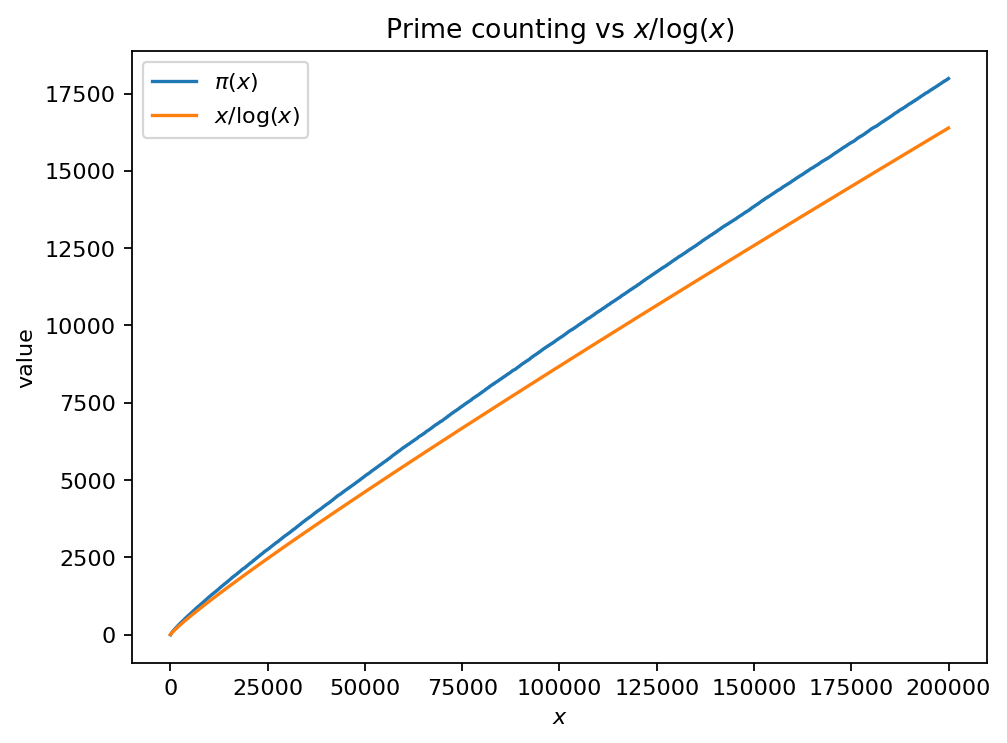
Published run: \(\text{n}_{\max} = 200\,000\) and \(\pi(\text{n}_{\max}) = 17\,984\)
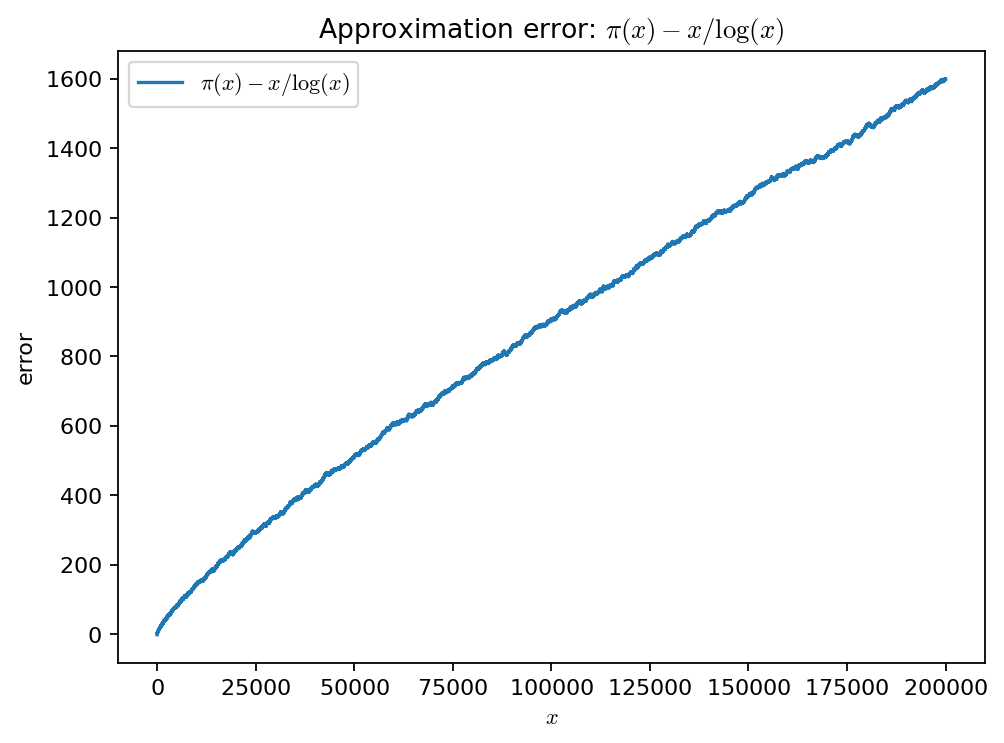
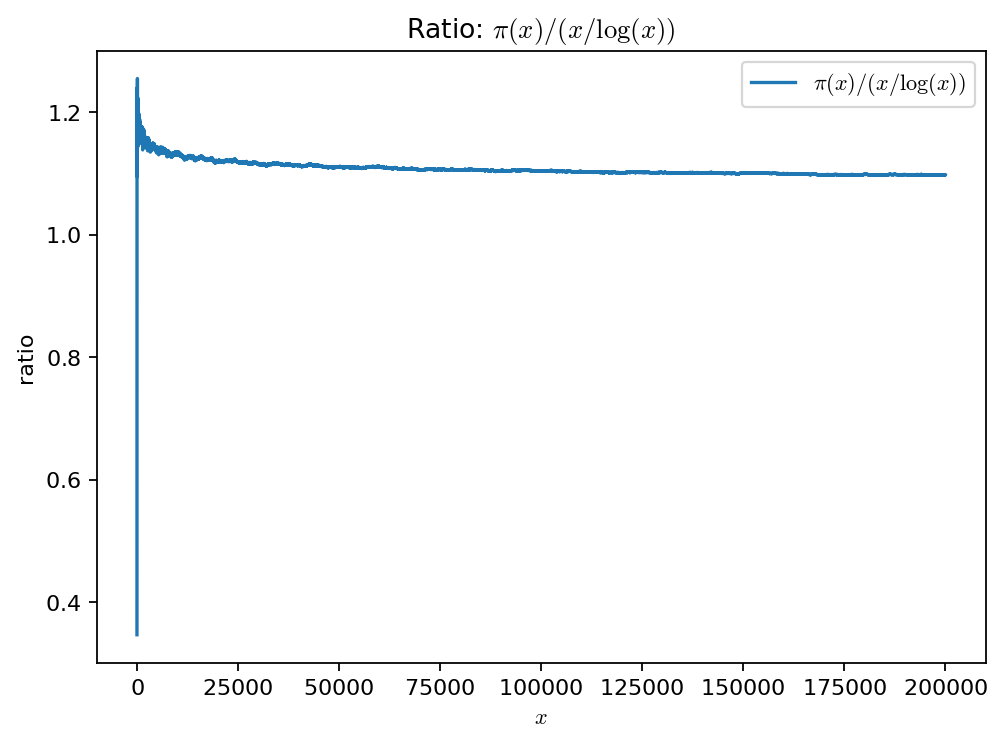
Published run: \(\text{n}_{\max} = 2\,000\,000\) and \(\pi(\text{n}_{\max}) = 148\,933\)
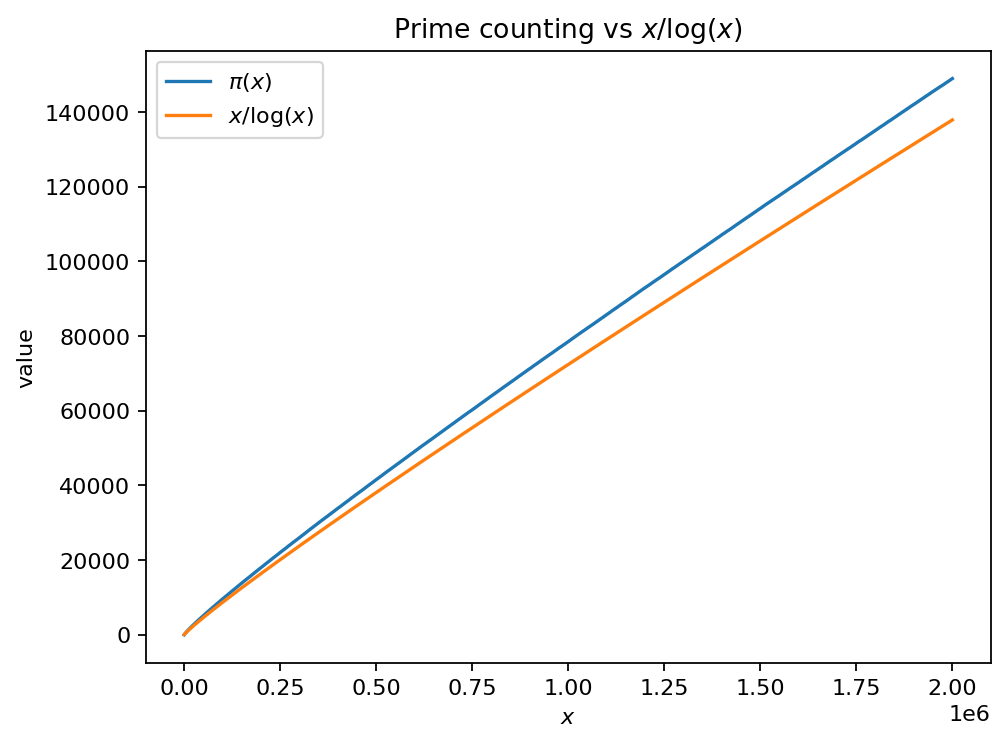
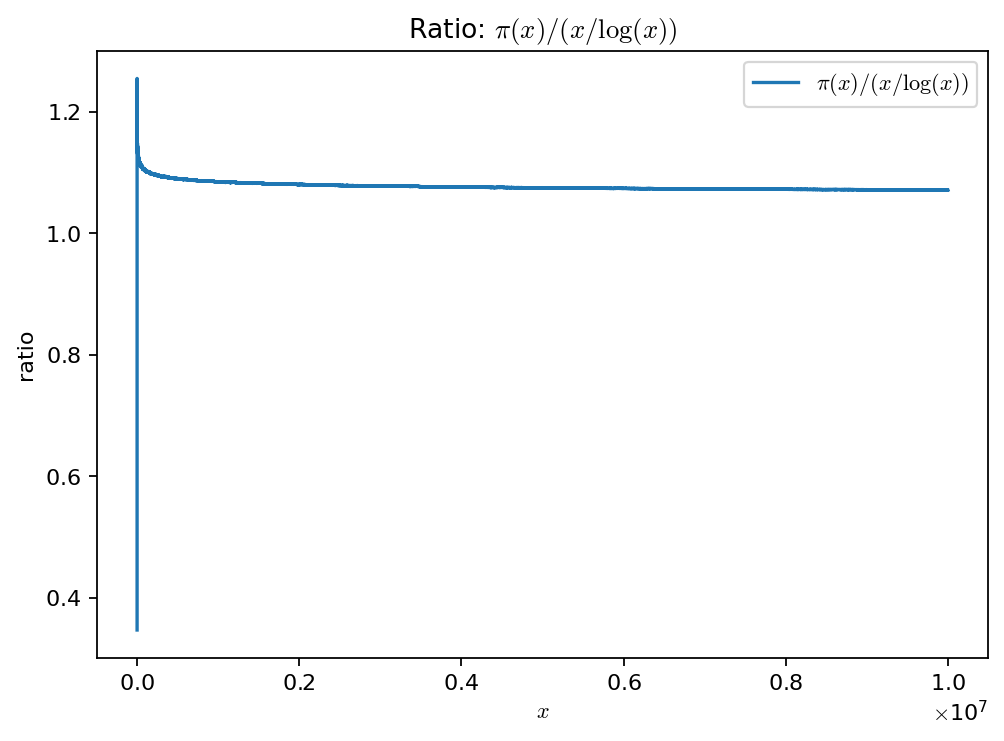
Published run: \(\text{n}_{\max} = 10\,000\,000\) and \(\pi(\text{n}_{\max}) = 664\,579\)
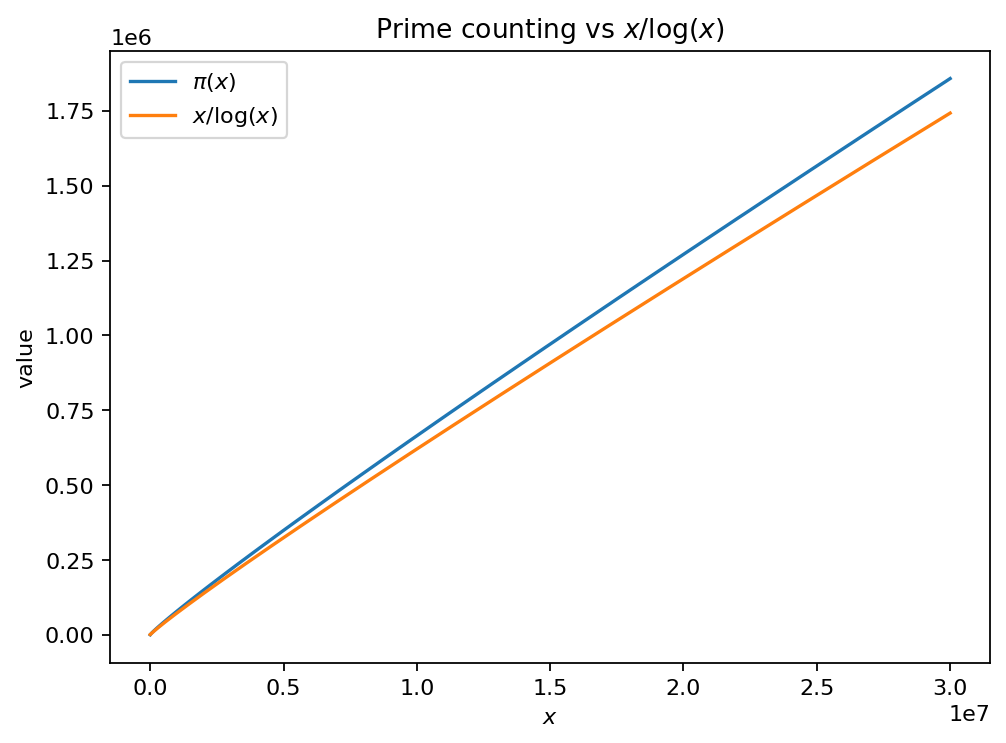
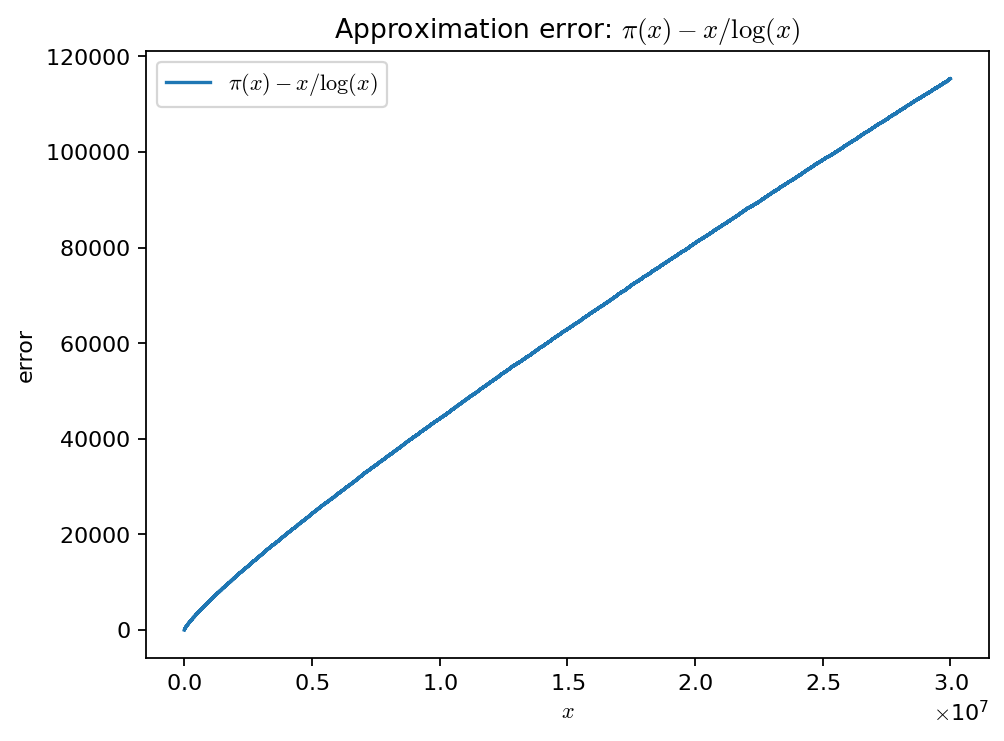
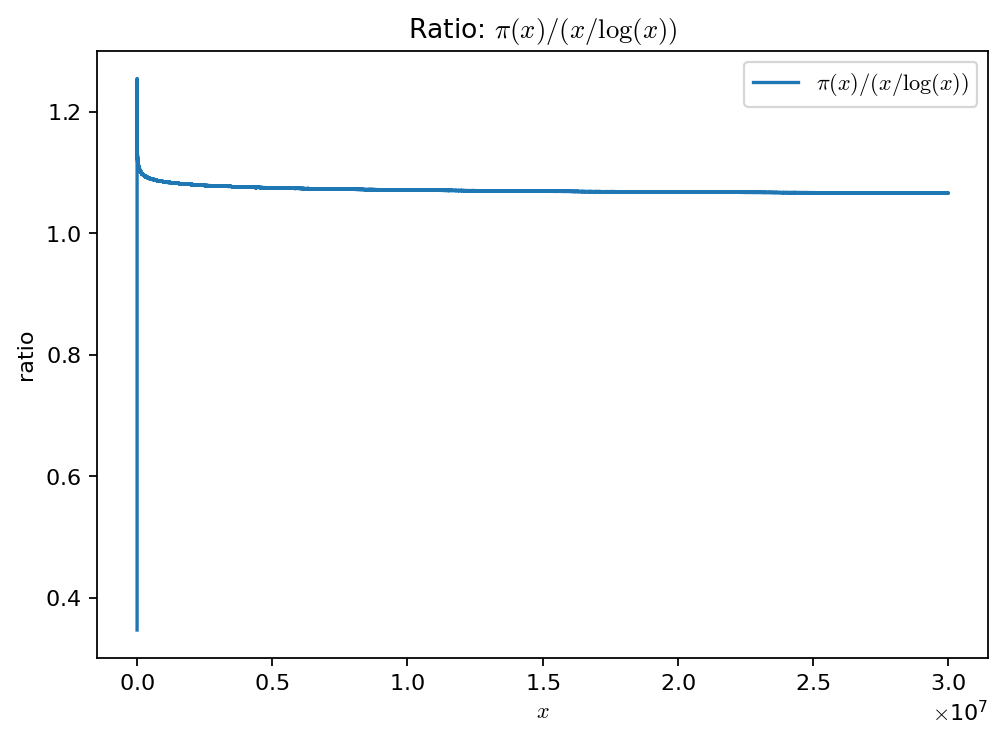
Published run: \(\text{n}_{\max} = 30\,000\,000\) and \(\pi(\text{n}_{\max}) = 1\,857\,859\)
Prime counts shown are \(\pi(\text{n}_{\max})\), i.e., the number of primes \(\le \text{n}_{\max}\). In this experiment we evaluate \(\pi(x)\) for all integers \(x\) with \(2 \le x \le \text{n}_{\max}\).
Tags: number-theory, quantitative-exploration, visualization
See: Valid Tags.
Highlights
Visual sanity check for your prime pipeline: compute \(\pi(x)\) from a sieve mask and compare to a standard smooth baseline.
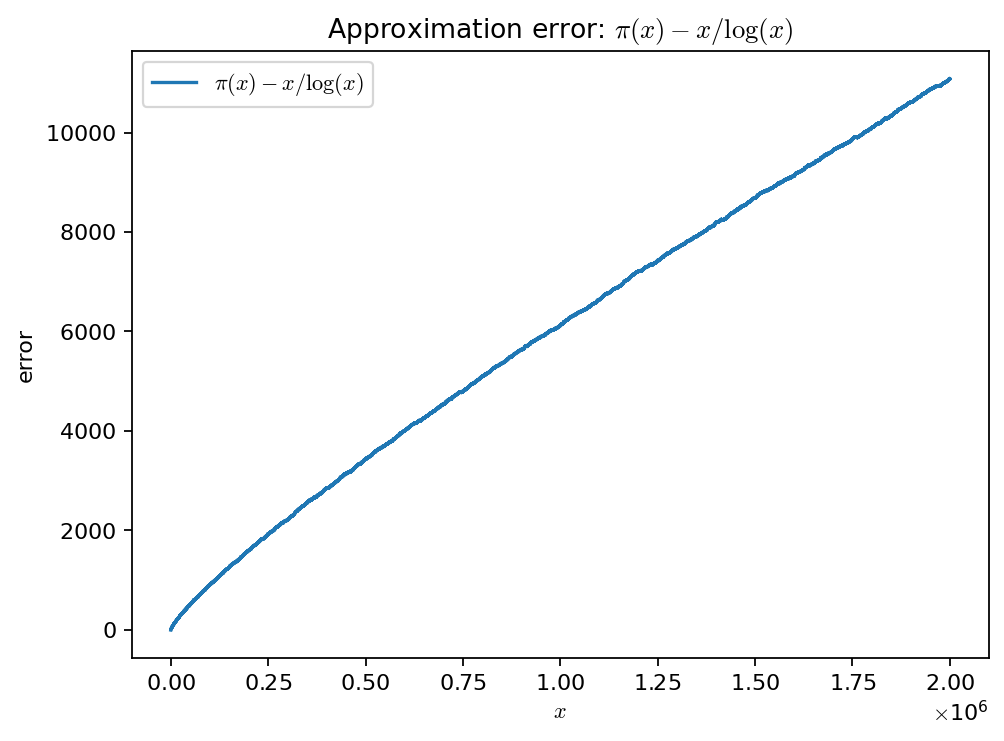
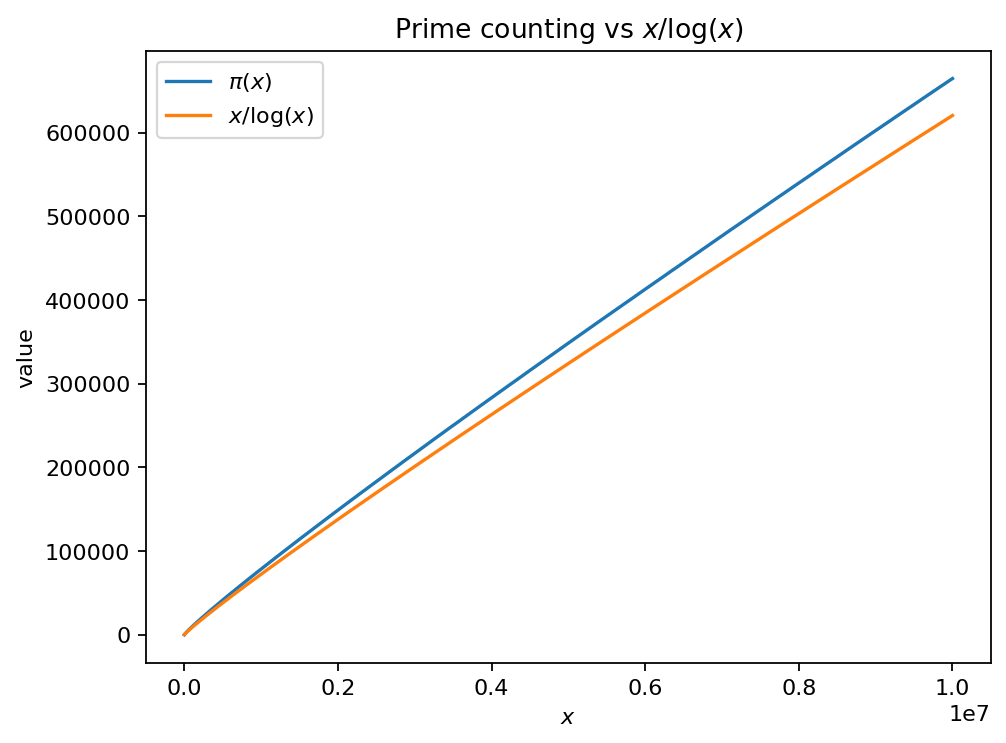
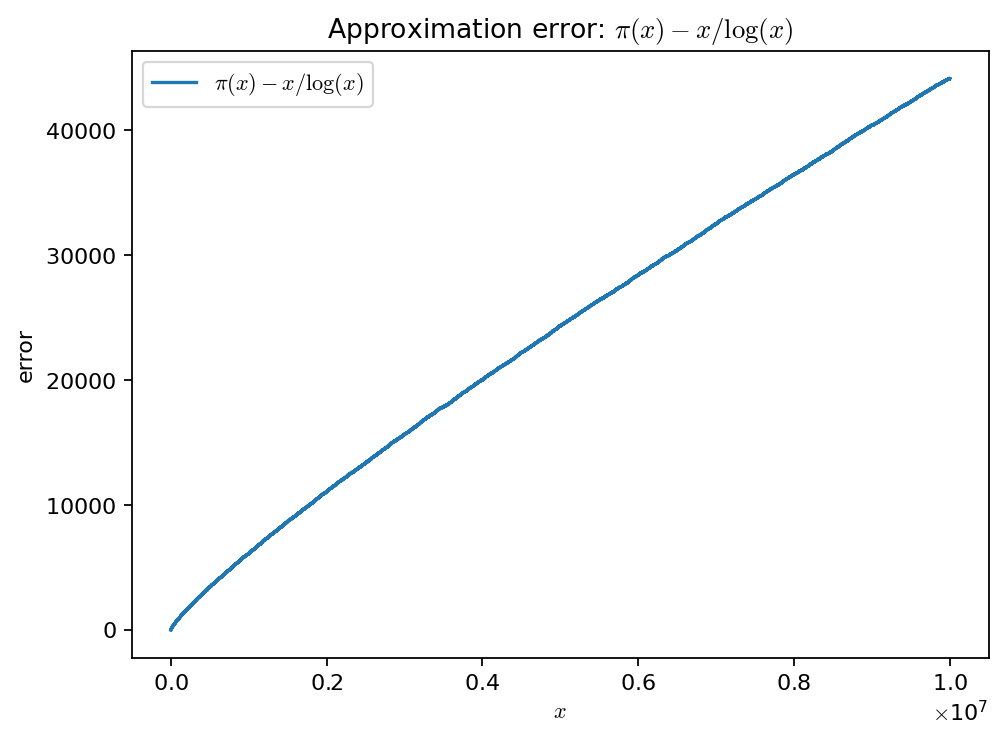
Two complementary plots: \(\pi(x)\) vs. \(x/\log(x)\), and the finite-range error curve \(\pi(x) - x/\log(x)\).
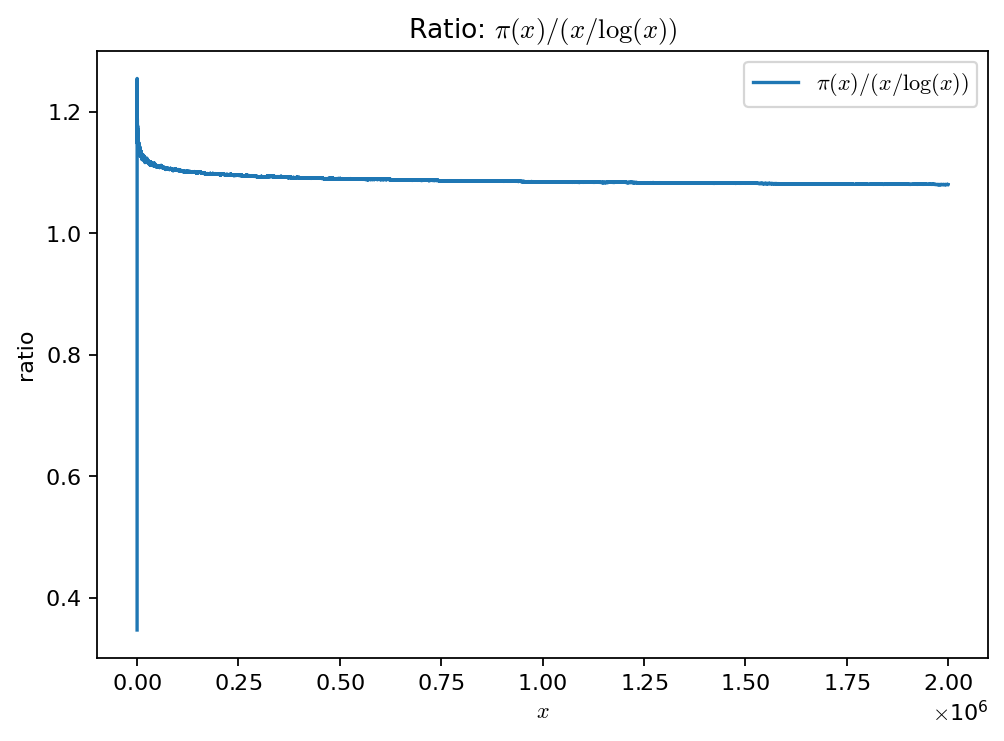
Ratio plot: \(\pi(x) / (x/\log(x))\) makes relative deviation visible when the two curves nearly overlap.
Writes reproducible artifacts (
params.json,report.md, and figures) intoout/e019/.
Goal
Visualize how well the Prime Number Theorem baseline \(x/\log(x)\) tracks the prime-counting function \(\pi(x)\) on a finite range and makes the approximation error visible.
Background (quick refresher)
Prime-counting function
The prime-counting function \(\pi(x)\) is the number of primes \(p\) with \(p \le x\).
The PNT baseline
The Prime Number Theorem (PNT) states that
Here \(\log\) is the natural logarithm. The symbol “\(\sim\)” is asymptotic: it does not claim the two expressions are close for small or moderate \(x\).
Optional background pages
Research question
On the finite range \(2 \le x \le \text{n}_{\max}\):
How close is \(x/\log(x)\) to \(\pi(x)\) as \(x\) grows?
What does the finite-range error \(\pi(x) - x/\log(x)\) look like (trend, scale, rough smoothness)?
Why this qualifies as a mathematical experiment
Finite procedure: compute primes up to \(\text{n}_{\max}\), then compute the cumulative count \(\pi(x)\).
Observable(s): the comparison curve \(\pi(x)\) vs. \(x/\log(x)\) and the finite-range error curve.
Parameter space: \(\text{n}_{\max}\) (and, if you extend it, sampling choices such as linear vs. log-spaced grids).
Outcome: figures plus a short report capturing the key observation and caveats.
Reproducibility: outputs saved to
out/e019/with a parameter snapshot.
Experiment design
Computation:
Build a prime mask for \(\{0,1,\dots,\text{n}_{\max}\}\) using a sieve.
Convert the mask to a cumulative array so that \(\pi(x)\) can be read off quickly.
For each integer \(x\) with \(2 \le x \le \text{n}_{\max}\), compute the baseline \(x/\log(x)\).
Axes (what the plots mean):
In the first plot, the horizontal axis is \(x\) and the vertical axis is a count: it shows \(\pi(x)\) and \(x/\log(x)\) for the same \(x\) values.
In the second plot, the horizontal axis is \(x\) and the vertical axis is the count difference \(\pi(x) - x/\log(x)\).
Outputs (typical):
figures/fig_01_pi_vs_x_logx.pngfigures/fig_02_pi_minus_x_logx.pngfigures/fig_03_pi_over_x_logx_ratio.pngparams.jsonreport.md
How to run
make run EXP=e019
Override the upper bound (computes primes up to \(\text{n}_{\max}\)):
make run EXP=e019 ARGS="--n-max 5000000"
Direct invocation (always works):
uv run --extra dev python -m mathxlab.experiments.e019 --out out/e019
# Override the upper bound:
uv run --extra dev python -m mathxlab.experiments.e019 --out out/e019 --n-max 5000000
Notes / pitfalls
Finite-range behavior: the PNT statement is asymptotic; interpret these plots as “finite-range behavior”.
Parameter exposure: use
--n-maxto change \(\text{n}_{\max}\); keep published snapshots consistent withparams.json/report.md.Scale masking: on a linear axis, \(\pi(x)\) and \(x/\log(x)\) are close in relative terms, so runs with different \(\text{n}_{\max}\) can look very similar. Use the ratio plot \(\pi(x) / (x/\log(x))\) for a relative view.
Log domain: avoid \(x=0\) or \(x=1\) because \(\log(x)\) is \(0\) or undefined there; we start at \(x=2\).
Visual overclaims: a smooth-looking error curve does not imply a theorem about error terms.
Extensions
Add a second baseline \(\mathrm{Li}(x)\) and compare \(\pi(x) - \mathrm{Li}(x)\).
Add explicit bounds (Rosser–Schoenfeld / Dusart) and visualize which ranges they dominate.
Add a sampling mode:
linear: evaluate all integers \(x\) (current version), and
log: evaluate a log-spaced grid to “see” larger scales more evenly.
Published run snapshot
Reproduce:
make run EXP=e019
Parameters
n_max:
2000000
Notes
The Prime Number Theorem suggests \(\pi(x) ~ x/\log(x)\).
The error curve shows the approximation improves overall but wiggles persist.
Ratio view: \(\pi(x) / (x/\log(x))\) highlights relative deviation.
params.json (snapshot)
{
  "n_max": 2000000
}
References
Prime-counting function overview: [Wikipedia contributors, 2025].
Analytic number theory background and PNT context: [Apostol, 1976].
Classic reference for \(\pi(x)\), error terms, and explicit-formula viewpoints: [Titchmarsh, 1986].
See also References.
Parameters (example)
\(\text{n}_{\max}\):
2_000_000(range: \(2 \le x \le \text{n}_{\max}\))
Recommended \(\text{n}_{\max}\) range
This experiment classifies primes up to \(\text{n}_{\max}\) using a sieve, so runtime and memory scale roughly with \(\text{n}_{\max}\).
A practical range that works well for most runs:
Minimum (still meaningful): \(\text{n}_{\max} = 200\,000\)
Default / recommended: \(\text{n}_{\max} = 2\,000\,000\)
Comfortable upper range on typical laptops (varies): \(\text{n}_{\max} = 10\,000\,000\)
Above ~\(\text{n}_{\max} = 30\,000\,000\): expect noticeably higher runtime (and potentially memory pressure), depending on the machine and sieve implementation.
Summary
We compute the prime-counting function \(\pi(x)\) up to \(\text{n}_{\max}=2\,000\,000\) and compare it to the smooth baseline \(x/\log(x)\) on the same range.
Key observations
The baseline \(x/\log(x)\) tracks the overall growth of \(\pi(x)\) but underestimates it on this range.
The error curve \(\pi(x)-x/\log(x)\) is positive and grows to about \(11\,084\) at \(x=2\,000\,000\).
Interpretation
This is exactly the kind of behavior the PNT suggests: \(\pi(x)\) is “close to” \(x/\log(x)\) in a relative sense, but the absolute difference can still be large on finite ranges. The plots are therefore best read as finite-range behavior rather than as a direct numerical validation of the asymptotic statement.
Caveats
The PNT statement is asymptotic: do not treat any single finite-range plot as proof.
Visualization choices (sampling density, line smoothing, axis scaling) can make convergence look better or worse than it is.
For better baselines on moderate ranges, comparing to \(\mathrm{Li}(x)\) is often more informative (see the related experiment).