E056: Liouville vs. Möbius walks
Tags: number-theory, quantitative-exploration, visualization, arithmetic-functions, summatory, liouville, mobius
See: Valid Tags.
Highlights
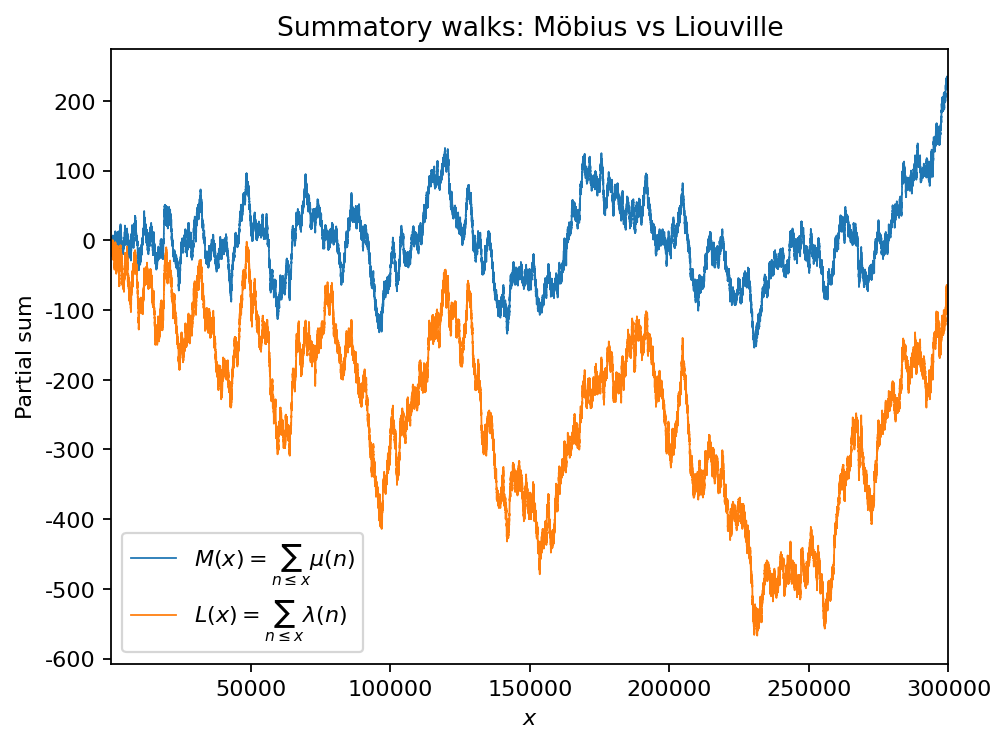
Plot partial sums of \(\lambda(n)\) and \(\mu(n)\) side by side.
Compare scaled versions to see how the inclusion/exclusion of squareful terms changes the walk.
Goal
Contrast two closely related ±1/0 sequences arising from prime factorizations.
Background (quick refresher)
Research question
How do the fluctuations of \(\sum_{n\le x}\lambda(n)\) compare to \(\sum_{n\le x}\mu(n)\)?
Method
Compute \(\Omega(n)\), then \(\lambda(n)=(-1)^{\Omega(n)}\); compute \(\mu(n)\).
Plot partial sums and scaled partial sums (e.g., divide by \(\sqrt{x}\)).
How to run
make run EXP=e056uv run python -m mathxlab.experiments.e056
Outputs
This experiment follows the standard output contract:
out/e056/figures/— generated figures (PNG)out/e056/report.md— short narrative reportout/e056/manifest.json— snapshot metadata for the gallery
Published run snapshot
If this experiment is included in the docs gallery, include the published snapshot (report + params).
n_max: 300000
M(n_max) = 220
L(n_max) = -98
Figure:
fig_01_walks.png
params.json (snapshot)
{
  "n_max": 300000
}
References
See Tenenbaum [2015].