E006: Near Misses to Perfection
Tags: number-theory, conjecture-generation, visualization, numerics
See: Valid Tags.
Highlights
Search for \(n\) with \(\sigma(n)\) unusually close to \(2n\).
Build leaderboards for absolute and relative deviation.
Visualize how “near perfection” clusters by structure.
Goal
Find and visualize integers whose divisor sum is unusually close to the perfect condition \(\sigma(n)=2n\), without being perfect.
Research question
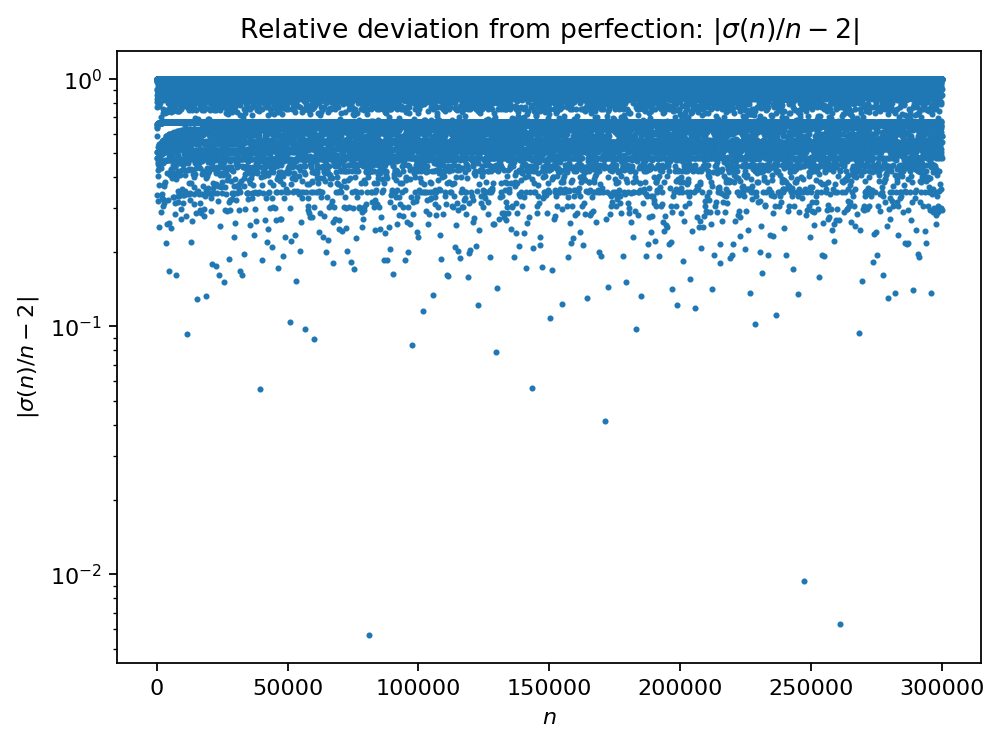
For integers \(n \le N\), which numbers minimize:
absolute deviation:
\[ D_1(n) = |\sigma(n)-2n| \]relative deviation:
\[ D_2(n) = \left|\frac{\sigma(n)}{n}-2\right|? \]
Do “near misses” cluster in recognizable families (highly composite, abundant, etc.)?
Why this qualifies as a mathematical experiment
The perfect condition is a sharp equality. Studying the closest failures often reveals structure and suggests new questions (e.g., which multiplicative patterns drive \(\sigma(n)\) toward \(2n\)).
Experiment design
Computation
Compute \(\sigma(1..N)\) via the divisor-sum sieve (as in E003).
For each \(n\), compute \(D_1(n)\) and \(D_2(n)\).
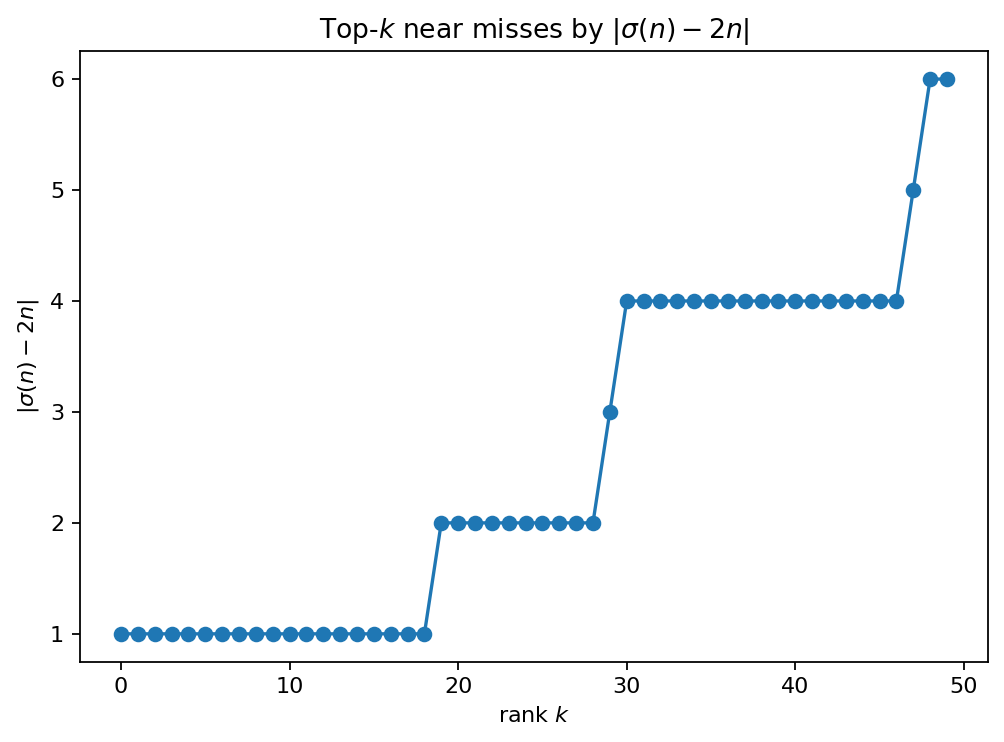
Keep the top-\(k\) smallest deviations (excluding actual perfect numbers).
Outputs
table: top-\(k\) near misses (with \(n\), \(\sigma(n)\), \(D_1\), \(D_2\))
plot: \(n\) vs. \(D_2(n)\) (log-scale on \(D_2\) often helps)
mark perfect numbers for reference
How to run
make run EXP=e006
or:
uv run python -m mathxlab.experiments.e006
Notes / pitfalls
Use integer comparisons to identify perfect numbers (
sigma[n] == 2*n).For \(D_2\), floats are fine for plotting, but store exact rational values for ranking when possible (e.g., compare \(|\sigma(n)-2n|\) first, then normalize for reporting).
Choose \(k\) small (e.g. 50 or 200) so the report stays readable.
Extensions
Repeat for different \(N\) and compare stability of the “near miss” leaderboard.
Add a second leaderboard restricted to odd \(n\) only.
Compare near misses to known abundant/deficient classifications and prime factorizations.
Published run snapshot
If this experiment is included in the docs gallery, include the published snapshot (report + params).
Reproduce:
make run EXP=e006
Parameters
N:
300000top_k:
50
Top near misses (excluding perfect numbers)
| n | σ(n) | |σ(n)-2n| | |σ(n)/n - 2| | |—:|—:|—:|—:| | 131072 | 262143 | 1 | 7.62939e-06 | | 8192 | 16383 | 1 | 0.00012207 | | 262144 | 524287 | 1 | 3.8147e-06 | | 64 | 127 | 1 | 0.015625 | | 32768 | 65535 | 1 | 3.05176e-05 | | 4096 | 8191 | 1 | 0.000244141 | | 65536 | 131071 | 1 | 1.52588e-05 | | 32 | 63 | 1 | 0.03125 | | 2048 | 4095 | 1 | 0.000488281 | | 1024 | 2047 | 1 | 0.000976562 | | 16384 | 32767 | 1 | 6.10352e-05 | | 128 | 255 | 1 | 0.0078125 | | 2 | 3 | 1 | 0.5 | | 4 | 7 | 1 | 0.25 | | 1 | 1 | 1 | 1 | | 512 | 1023 | 1 | 0.00195312 | | 8 | 15 | 1 | 0.125 | | 16 | 31 | 1 | 0.0625 | | 256 | 511 | 1 | 0.00390625 | | 136 | 270 | 2 | 0.0147059 | | 32896 | 65790 | 2 | 6.07977e-05 | | 1952 | 3906 | 2 | 0.00102459 | | 3 | 4 | 2 | 0.666667 | | 130304 | 260610 | 2 | 1.53487e-05 | | 650 | 1302 | 2 | 0.00307692 | | 10 | 18 | 2 | 0.2 | | 20 | 42 | 2 | 0.1 | | 464 | 930 | 2 | 0.00431034 | | 104 | 210 | 2 | 0.0192308 | | 18 | 39 | 3 | 0.166667 | | 2144 | 4284 | 4 | 0.00186567 | | 18632 | 37260 | 4 | 0.000214684 | | 70 | 144 | 4 | 0.0571429 | | 1888 | 3780 | 4 | 0.00211864 | | 110 | 216 | 4 | 0.0363636 | | 4030 | 8064 | 4 | 0.000992556 | | 884 | 1764 | 4 | 0.00452489 | | 14 | 24 | 4 | 0.285714 | | 12 | 28 | 4 | 0.333333 | | 5 | 6 | 4 | 0.8 | | 44 | 84 | 4 | 0.0909091 | | 8384 | 16764 | 4 | 0.000477099 | | 32128 | 64260 | 4 | 0.000124502 | | 152 | 300 | 4 | 0.0263158 | | 5830 | 11664 | 4 | 0.000686106 | | 116624 | 233244 | 4 | 3.42983e-05 | | 88 | 180 | 4 | 0.0454545 | | 9 | 13 | 5 | 0.555556 | | 315 | 624 | 6 | 0.0190476 | | 7 | 8 | 6 | 0.857143 |
Notes
Ranking is primarily by absolute deviation |σ(n)-2n|, with relative deviation reported for context.
params.json (snapshot)
{
  "n_max": 300000,
  "stride_scatter": 10,
  "top_k": 50
}
References
See References.