E049: Wieferich primes (base 2): scan and quotient visualization
Tags: number-theory, counterexample-search, visualization, wieferich
See: Valid Tags.
Highlights
Scans primes up to a bound for the Wieferich condition \(2^{p-1}\equiv 1\ (\mathrm{mod}\ p^2)\).
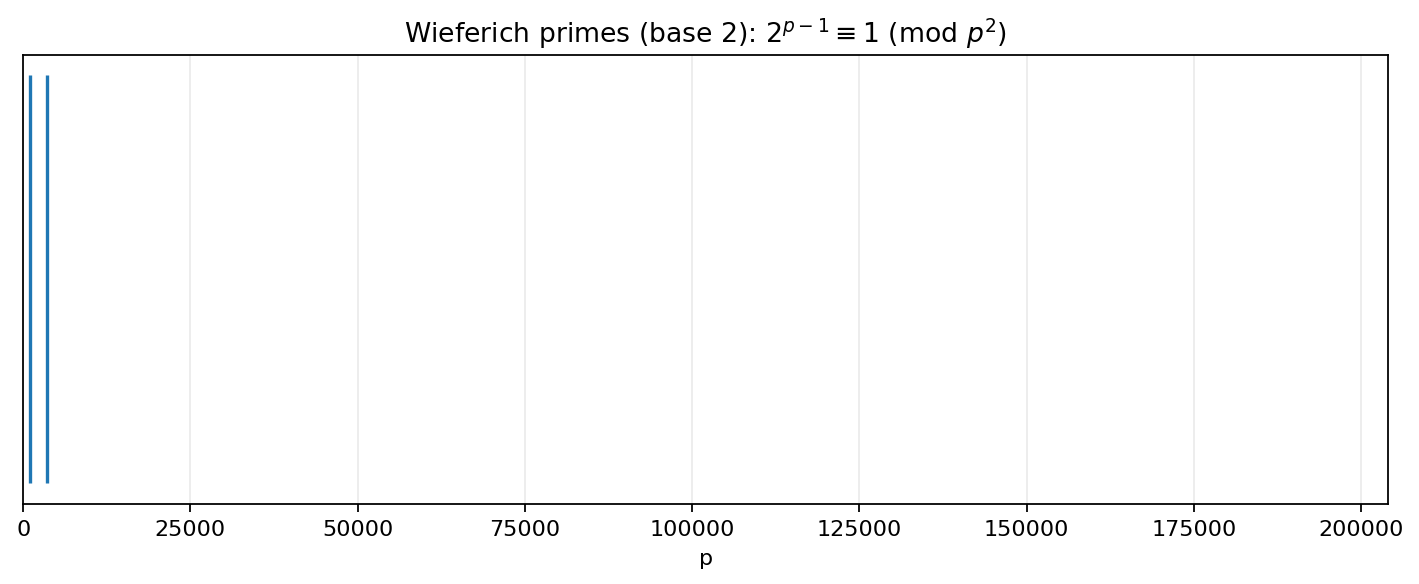
Recovers the known small hits (1093 and 3511) under default settings.
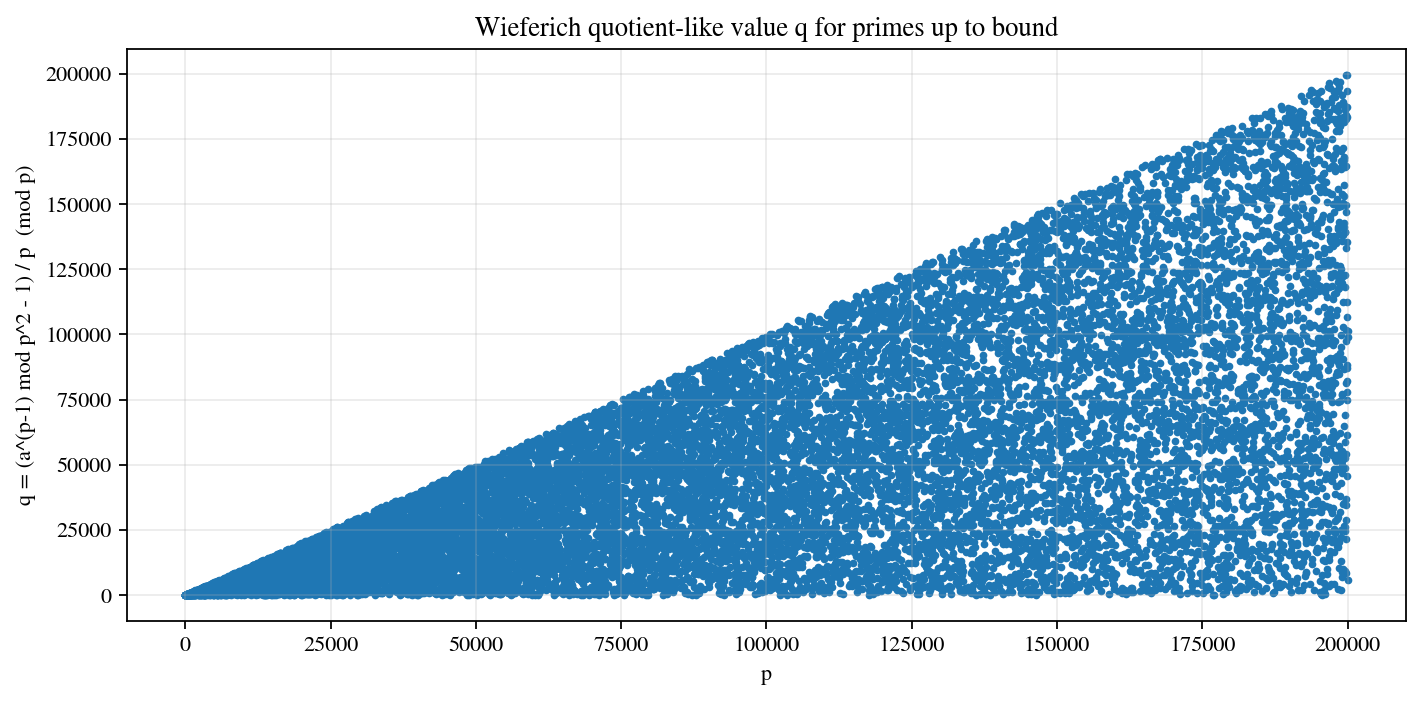
Visualizes a quotient-like value that is exactly zero for Wieferich primes.
Goal
Explore a rare strengthening of Fermat’s congruence and visualize how exceptional Wieferich primes are.
Background (quick refresher)
Research question
Up to a bound \(B\), which primes satisfy the Wieferich condition (base 2), and how does the quotient-like statistic vary across primes?
Experiment design
Generate all primes \(p\le B\) (excluding \(p=2\) for base 2).
Compute \(r = 2^{p-1} \bmod p^2\) and derive \(q = (r-1)/p\ (\mathrm{mod}\ p)\).
Mark primes with \(q=0\) as Wieferich hits.
Plot hit positions and a scatter of \(q\) values.
Reproducibility
params.jsonrecords the run settings.report.mdsummarizes the key findings.figures/*.pngcontains the plots for the run.
Interpreting the results
Hits at 1093 and 3511 confirm the implementation.
The quotient scatter is purely exploratory; it’s a compact way to see “how far” a prime is from the Wieferich condition.
Increasing the bound quickly becomes compute-heavy (but remains feasible for moderate bounds in pure Python).
Published run snapshot
If this experiment is included in the docs gallery, include the published snapshot (report + params).
Parameters
p_max: 200000
base: 2
Hits
Wieferich primes found within the scan bound:
1093, 3511
Notes
For base 2, the smallest known Wieferich primes are 1093 and 3511.
The scan here is purely computational and bounded.
params.json (snapshot)
{
  "base": 2,
  "p_max": 200000
}
References
See Wieferich [1909], The OEIS Foundation Inc. [2025], Wikipedia contributors [2025].