E050: Primorials and Euclid numbers: \(p\#\pm 1\) are usually composite
Tags: number-theory, counterexample-search, quantitative-exploration, visualization, primorial
See: Valid Tags.
Highlights
Computes primorials \(p_k\#=\prod_{i\le k} p_i\) and Euclid-style numbers \(p_k\#\pm 1\).
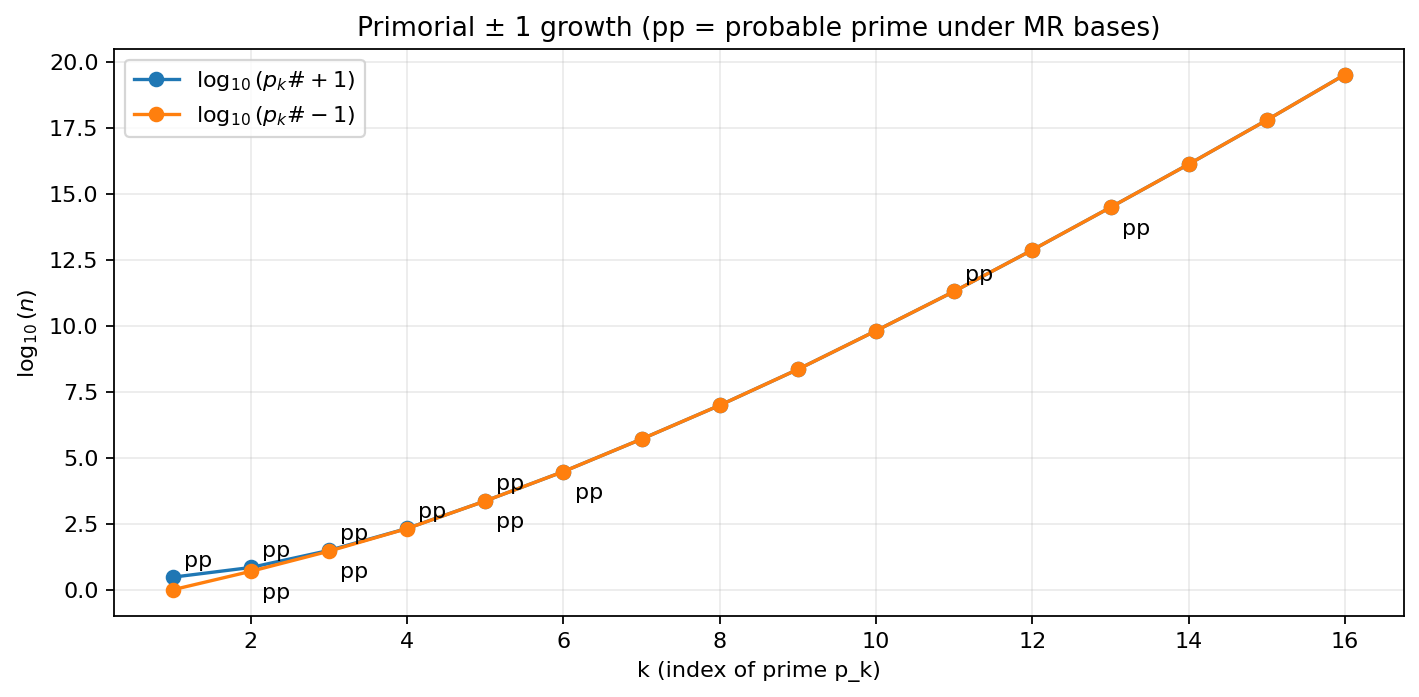
Uses a probable-prime test to show “often composite” behavior early.
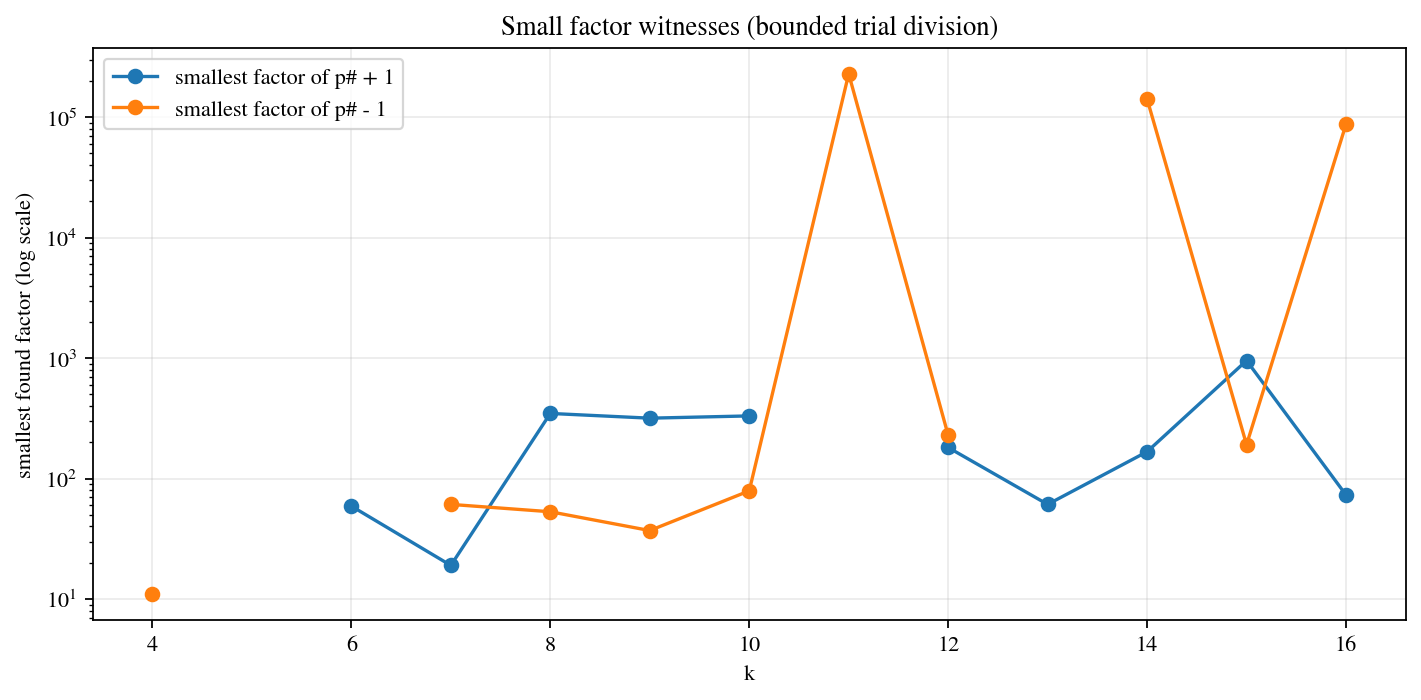
Finds small factor witnesses via bounded trial division for many early \(k\).
Goal
Demonstrate that Euclid-style numbers are coprime to small primes but are not reliably prime, and produce explicit factor witnesses.
Background (quick refresher)
Research question
For small \(k\), how often are \(p_k\#\pm 1\) prime (or probable prime), and how easy is it to find a small factor when they are composite?
Experiment design
Compute primorials for \(k\le k_{max}\).
Test \(p_k\#\pm 1\) with Miller–Rabin (probable prime).
If composite under MR, try to find a small trial-division factor as a concrete witness.
Plot \(\log_{10}(p_k\#\pm 1)\) and smallest factor witnesses (log scale).
Reproducibility
params.jsonrecords the run settings.report.mdsummarizes the key findings.figures/*.pngcontains the plots for the run.
Interpreting the results
“Probable prime” is not a proof; it’s a fast filter for this exploratory experiment.
Factor witnesses come from bounded trial division: not finding a factor is expected for some \(k\).
You should see early composite examples such as \(p_6\#+1=30031\) (with a small factor) under default bounds.
Published run snapshot
If this experiment is included in the docs gallery, include the published snapshot (report + params).
Parameters
k_max: 16
factor_prime_bound: 1000000
mr_bases: 2, 3, 5, 7, 11, 13, 17
Results
k |
p_k# + 1 |
pp? |
factor |
p_k# - 1 |
pp? |
factor |
|---|---|---|---|---|---|---|
1 |
3 |
✅ |
— |
1 |
❌ |
— |
2 |
7 |
✅ |
— |
5 |
✅ |
— |
3 |
31 |
✅ |
— |
29 |
✅ |
— |
4 |
211 |
✅ |
— |
209 |
❌ |
11 |
5 |
2311 |
✅ |
— |
2309 |
✅ |
— |
6 |
30031 |
❌ |
59 |
30029 |
✅ |
— |
7 |
510511 |
❌ |
19 |
510509 |
❌ |
61 |
8 |
9699691 |
❌ |
347 |
9699689 |
❌ |
53 |
9 |
223092871 |
❌ |
317 |
223092869 |
❌ |
37 |
10 |
6469693231 |
❌ |
331 |
6469693229 |
❌ |
79 |
11 |
200560490131 |
✅ |
— |
200560490129 |
❌ |
228737 |
12 |
7420738134811 |
❌ |
181 |
7420738134809 |
❌ |
229 |
13 |
304250263527211 |
❌ |
61 |
304250263527209 |
✅ |
— |
14 |
13082761331670031 |
❌ |
167 |
13082761331670029 |
❌ |
141269 |
15 |
614889782588491411 |
❌ |
953 |
614889782588491409 |
❌ |
191 |
16 |
32589158477190044731 |
❌ |
73 |
32589158477190044729 |
❌ |
87337 |
Notes
pp?is probable prime under the chosen Miller–Rabin bases.Factor witnesses are from bounded trial division (not a full factorization).
params.json (snapshot)
{
  "factor_prime_bound": 1000000,
  "k_max": 16,
  "mr_bases": [
    2,
    3,
    5,
    7,
    11,
    13,
    17
  ]
}
References
See Hardy and Wright [2008], The OEIS Foundation Inc. [2025], Prime Pages (UTM) [2025], Wikipedia contributors [2025].