E046: Prime-testing pipeline and tuning pitfalls
Tags: number-theory, quantitative-exploration, visualization
See: Valid Tags.
Highlights
This is a thin wrapper that follows the standard experiment template and delegates the actual computation to :mod:
mathxlab.experiments.prime_suite.Writes reproducible artifacts (
params.json,report.md, and figures).Designed to surface patterns and “looks-true-until-it-breaks” behavior.
Goal
This is a thin wrapper that follows the standard experiment template and delegates the actual computation to :mod:mathxlab.experiments.prime_suite.
Background (quick refresher)
Research question
Which prime-related claim, heuristic, or algorithm breaks first under a clean, controlled computational sweep, and what does the smallest or clearest counterexample (or deviation) look like?
Why this qualifies as a mathematical experiment
Finite procedure: run a bounded search / sweep with recorded parameters.
Observable(s): counts, gaps, residues, runtime scaling, or first counterexample witnesses.
Parameter space: vary bounds (and sometimes algorithmic choices).
Outcome: plots/tables + “witness objects” for failures.
Reproducibility: outputs saved to
out/e046/with a parameter snapshot.
Experiment design
Computation: bounded enumeration / sampling with explicit limits.
Outputs: figures and a short
report.mdsummarizing what was found.Artifacts written:
figures/fig_*.pngparams.jsonreport.md
How to run
make run EXP=e046
or:
uv run python -m mathxlab.experiments.e046
Notes / pitfalls
“No counterexample found” only means “none found within the configured bounds”.
For probabilistic tests (when used), treat outcomes as evidence, not proof.
Extensions
Increase bounds and rerun (recording runtime and memory).
Compare alternative heuristics or algorithms on the same parameter grid.
Turn found deviations into new, tighter conjectures.
Published run snapshot
If this experiment is included in the docs gallery, include the published snapshot (report + params).
Reproduce:
make run EXP=e046
Parameters
n_max:
2000000mr_bases:
[2, 3, 5]
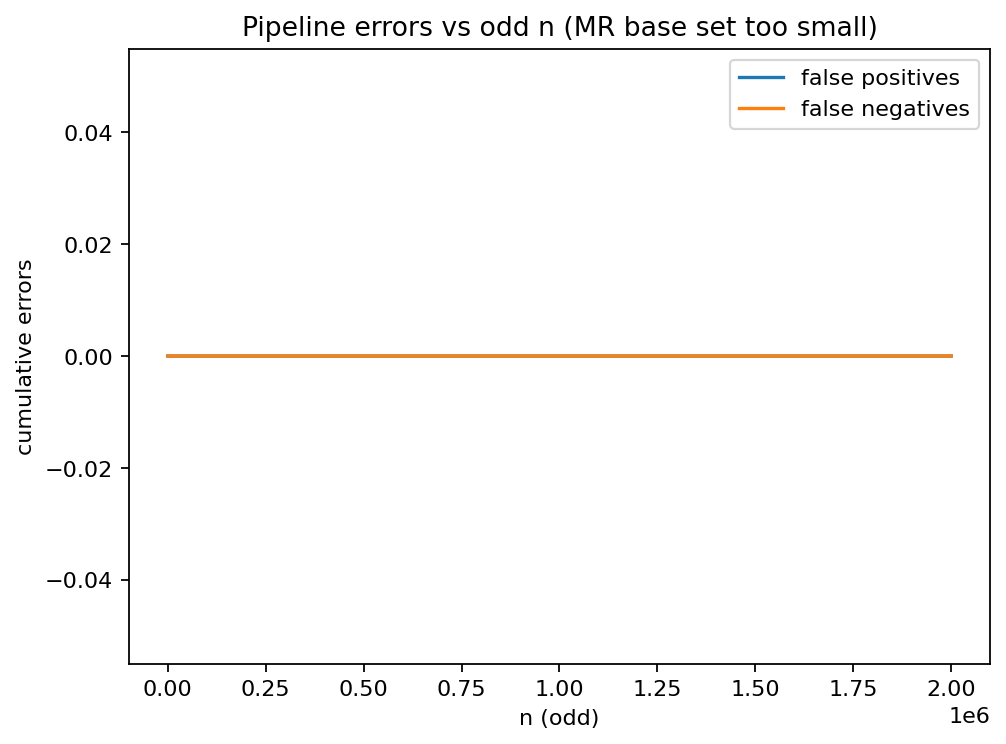
First false positives (composites that passed MR stage)
none in this range
Notes
Pipelines are great for speed, but correctness depends on parameters.
This experiment intentionally uses too few MR bases to produce counterexamples.
params.json (snapshot)
{
  "mr_bases": [
    2,
    3,
    5
  ],
  "n_max": 2000000
}
References
See References.