E079: Primitive vs. imprimitive characters: conductors.
Tags: number-theory, quantitative-exploration, visualization, dirichlet-characters
Highlights
Uses character orthogonality to reconstruct residue indicators.
Measures reconstruction error / maximal partial sums across characters.
Explores how primitive characters vary with the modulus.
What this experiment does
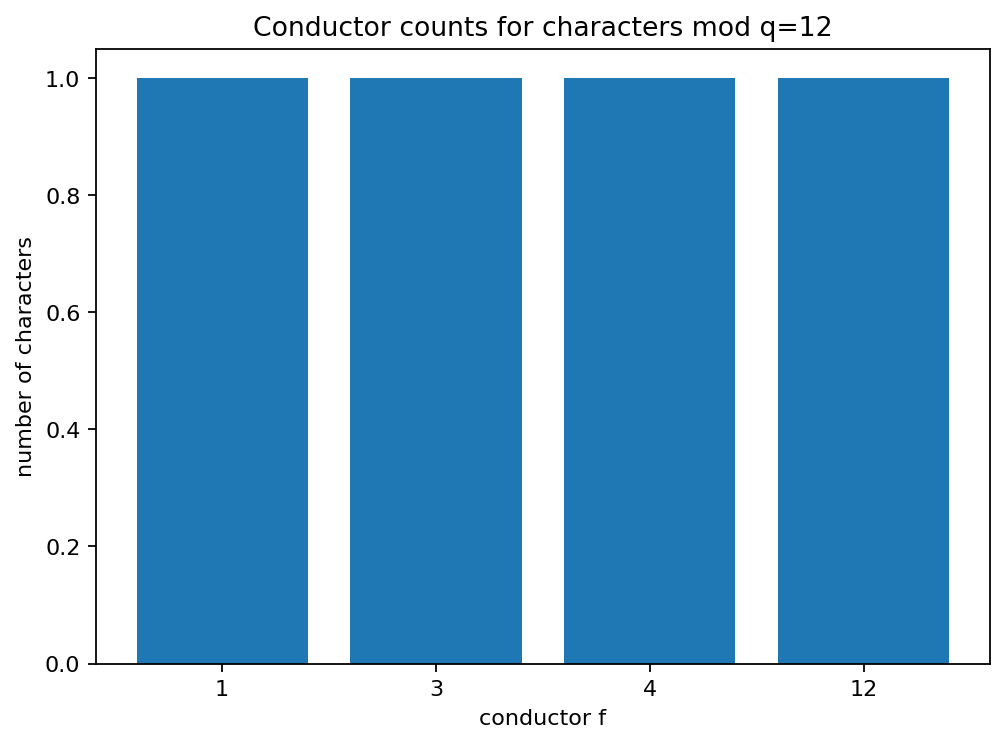
A character modulo q may factor through a smaller modulus f | q. The smallest such modulus is the conductor of the character.
The implementation focuses on a compact, reproducible numerical workflow: deterministic parameter defaults, structured output folders, and one or more figures saved for the gallery.
Outputs
This experiment writes into out/e079/:
figures/fig_01_conductor_counts.png
How to run
make run EXP=e079
Notes
The gallery preview figure shipped with the documentation uses conservative cutoffs so builds stay fast. If you run the experiment locally, increase the cutoffs to see the asymptotic regime more clearly.
Prime-race plots depend on the chosen sampling of
x(linear vs. log grid). The qualitative “who leads” picture can change when you zoom in.
Published run snapshot
If this experiment is included in the docs gallery, include the published snapshot (report + params).
q: 12
phi(q): 4
number of primitive characters (conductor = q): 1
Conductor breakdown:
f=1: 1
f=3: 1
f=4: 1
f=12: 1
Figure:
fig_01_conductor_counts.png
Notes:
Conductor computation here is a brute-force check intended for small q.
params.json (snapshot)
{
  "q": 12
}