E054: Squarefree density via Möbius
Tags: number-theory, quantitative-exploration, visualization, arithmetic-functions, mobius, summatory
See: Valid Tags.
Highlights
Use \(\mu(n)^2\) as an indicator for squarefree integers.
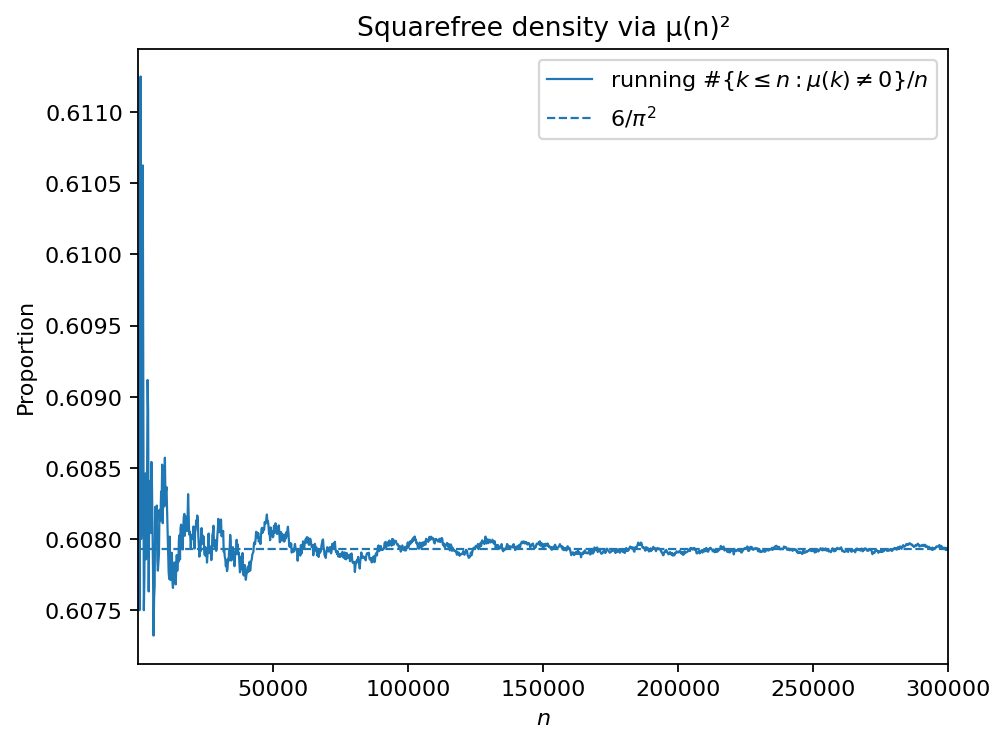
Plot the running density and compare to \(6/\pi^2\).
Goal
Show how an arithmetic function encodes a classic density result.
Background (quick refresher)
Research question
How quickly does the empirical density of squarefree numbers approach \(6/\pi^2\)?
Method
Compute \(\mu(n)\) up to \(N\) and accumulate \(\sum_{n\le x}\mu(n)^2\).
Plot the ratio \(\frac{1}{x}\sum_{n\le x}\mu(n)^2\) with a reference line at \(6/\pi^2\).
How to run
make run EXP=e054uv run python -m mathxlab.experiments.e054
Outputs
This experiment follows the standard output contract:
out/e054/figures/— generated figures (PNG)out/e054/report.md— short narrative reportout/e054/manifest.json— snapshot metadata for the gallery
Published run snapshot
If this experiment is included in the docs gallery, include the published snapshot (report + params).
n_max: 300000
observed squarefree proportion: 0.607927
theoretical density 6/pi^2: 0.607927
Figure:
fig_01_squarefree_density.png
params.json (snapshot)
{
  "n_max": 300000
}